Zumba vs Salsa and Bachata: What's the Difference? Exercise Class or Dancing with Partners
Contents
This page is a reference translation of the Japanese original (日本語の原文). It has not been checked by a native speaker. Please confirm details with each organizer.
Images on this site are AI-generated illustrations, not photographs of real people, places or events.
Spotted something unnatural or wrong? Please tell us through the correction form (the form is in Japanese, but you can write in English).
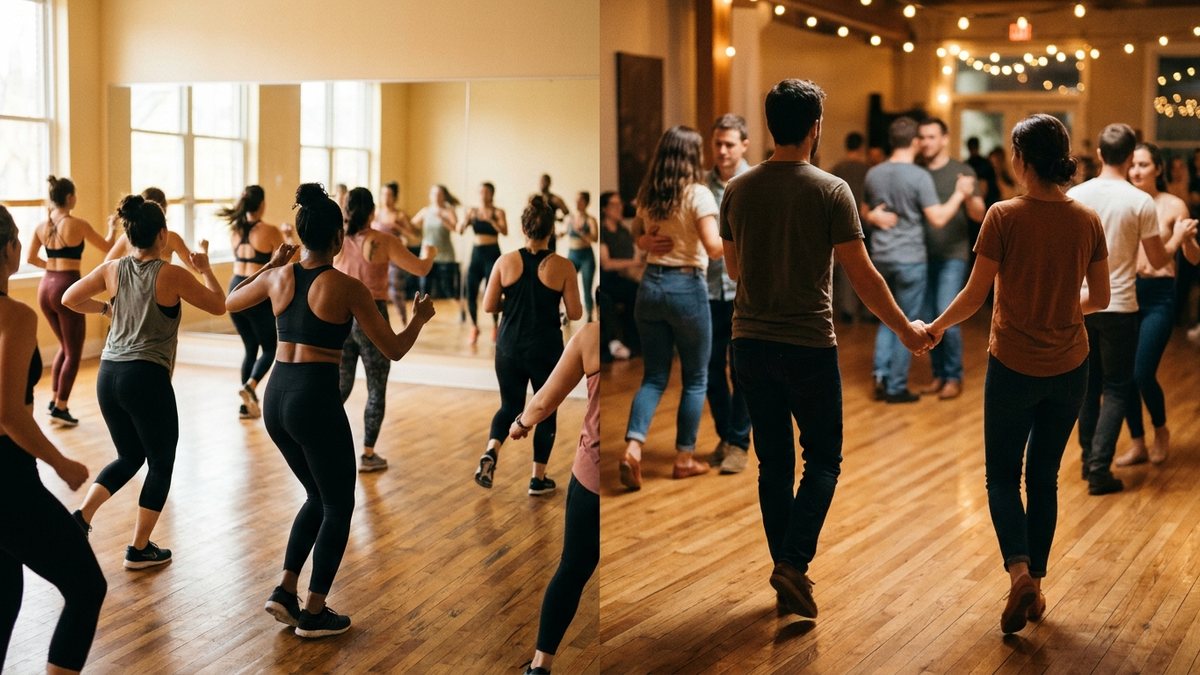
The short answer: Zumba (ZUMBA) and a salsa or bachata social (party) are different kinds of places, even though both use Latin-style music. In public sources, Zumba is described as a “fitness program,” and you dance to choreography that the instructor shows with movements and gestures. A salsa or bachata social, on the other hand, is a place where you pair up and dance with a partner, using the roles of lead and follow. Neither one is “better.” What you choose depends on what you want to do. This article sorts out what I could confirm in sources. How to choose by goal is written separately, as “my suggestion.”
- Zumba: A fitness program said to have been created by Beto Pérez, who is from Colombia. You dance to choreography, mostly to Latin music
- A salsa or bachata social: A place to enjoy a partner dance at a party, changing partners as you go. There are lead (the person who guides) and follow (the person who responds)
- How to choose: Is moving your body the main point, or dancing with people? You can do both (my suggestion)
About this article
I live in Sapporo and am around 50 years old. In 2019 I discovered salsa and bachata, and I still dance today. I am not good at dancing, and I am not a teacher. I have never taken a Zumba class. So for Zumba, I write only what I could confirm in public sources, and I show the sources. The scenes that start with “for example,” and the parts where I say “looks suitable” or “is safe” are my own suggestions. They are not anyone’s personal story. Where I could not confirm something, I say so.
What Is Zumba (ZUMBA)? Where It Came From
According to the Japanese-language Wikipedia, Zumba is the name of a fitness program created by Alberto “Beto” Pérez, a Colombian dancer and choreographer. In the narrow sense, it means exercise to music. In the wider sense, it is also used as a brand that includes other exercise programs and diet guidance, the article says.
This is how its start is explained.
- In Colombia in the 1990s, Pérez was an aerobics instructor. One day he forgot his music tapes, and he improvised choreography to Latin music tapes he had with him. That is said to be the start (Japanese-language Wikipedia). The English-language Wikipedia also says it began on a day he forgot his usual music and used salsa and merengue tapes, and that it was called “Rumbacize” at that time. The same story appears in the Philippine newspaper Philippine Star (2013) and in an NBC Philadelphia article. However, many articles put the time at “the mid-1990s,” while the origin of the tapes differs by article: “in a bag,” “in the car,” or “cassettes recorded from the radio” (CNBC). The details do not match
- The Japanese-language Wikipedia says Pérez moved from Colombia to the United States in 1999, and that the first Zumba class was held in Miami in 2001. Some articles also give 1999 for the move to the US (Jakarta Post, NBC Philadelphia), but Philippine Star gives 2001, so the sources differ. The founding year of the company (Zumba Fitness LLC) also does not match: the English-language article on Pérez and the Jakarta Post give 2006, and the English-language article on Zumba gives 2001
- About Japan, the Japanese-language Wikipedia explains that Pérez came to Japan in 2007, an instructor system was introduced, and classes started. I could not confirm this in other sources. There is a 2008 newspaper article (Ryukyu Shimpo) saying that Zumba had spread to more than 34 countries, including Japan. It suggests Zumba was already known in Japan around then
How the years and events are written differs a little by source. For example, for the origin of the name, the English-language Wikipedia says it came from a sound similar to “rumba,” and the Jakarta Post says “Sumba” was changed by replacing the first letter with a Z. But the Japanese-language Wikipedia says that “the word Zumba has no particular meaning, and was chosen as a brand name.” Please read the details as a range.
Also, ZUMBA is said to be a trademark of Zumba Fitness, LLC (English-language Wikipedia, Jakarta Post). In this article, I write “Zumba” as the general name, and “ZUMBA” only where needed. I could not open the official Zumba site (zumba.com) when I checked, so I could not confirm the official rules for how to write the name.
What Does a Zumba Class Look Like?
The Japanese-language Wikipedia explains it like this.
- Music: Mainly Latin music. It lists cumbia, salsa, merengue and reggaeton as essential elements. Other Latin and non-Latin genres are added to these, and J-POP was added from 2016, it is said
- Choreography: There are 4 basic moves for each of the 4 basic rhythms, and a class is built by combining them. The English-language Wikipedia also says there are 4 basic rhythms (salsa, reggaeton, merengue and cumbia), and Zumba’s own Help Center lists the 4 basic rhythms as merengue, salsa, cumbia and reggaeton
- How it runs: The Japanese-language Wikipedia says the lesson starts without any explanation beforehand, and the instructor basically does not use words but gives directions with movements and gestures. (I could not confirm in other sources that no words are used.) A 2008 Ryukyu Shimpo article also describes a form in which the instructor stands in front and dances, and the participants copy the moves
- Instructors: According to Zumba’s own Help Center, if you take the basic training (Basic 1; one day for in-person and live-stream formats, and about 10 hours of content for on-demand), you get a license valid for six months. If you belong to ZIN, the membership group for instructors, the license does not expire. The Japanese-language Wikipedia also explains that you can qualify through a short training course
There are several kinds of classes. The English-language Wikipedia introduces classes that use toning sticks, classes held in a pool, classes with intensity adjusted for older participants, and classes for children. Zumba’s own Help Center also lists kinds such as Step, Toning, Aqua, Sentao, Gold and Kids, and says Gold is for active older adults and beginners. Kinds and contents can change, so please check the notice for the actual class.
In the sources I checked, I found no description of pairing up and doing lead and follow in Zumba. What the sources describe is a form in which each person dances to the choreography the instructor shows.
What Does a Salsa or Bachata Social Look Like?
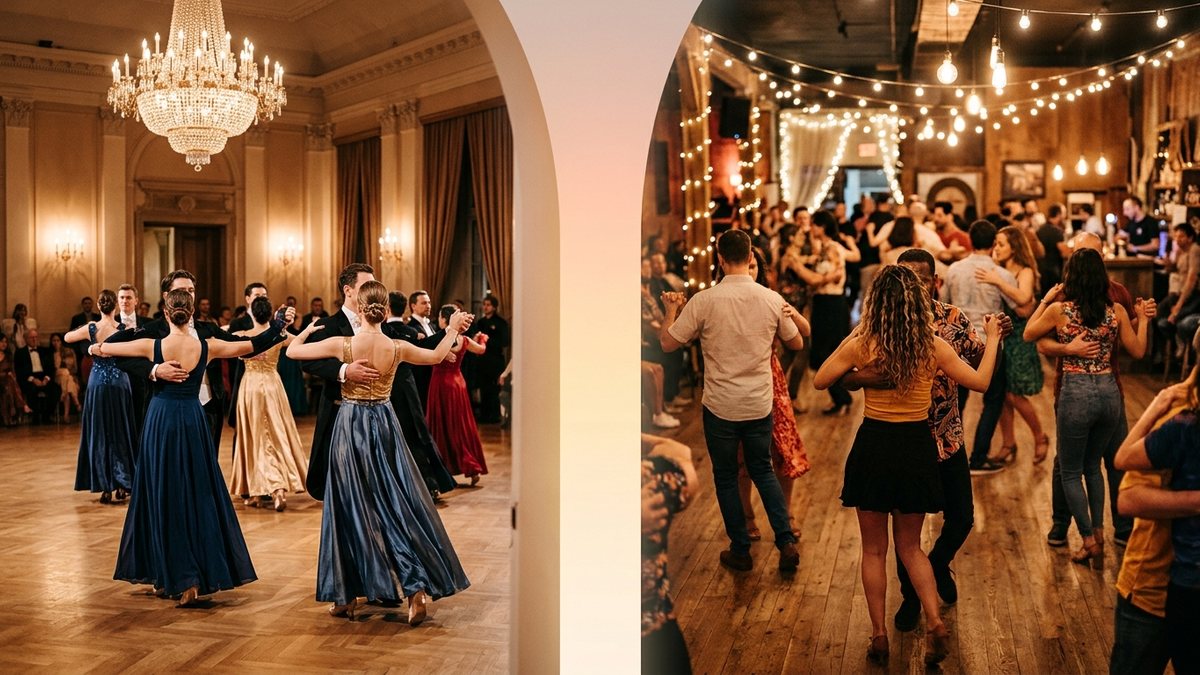
The typical place to dance salsa and bachata is a social (party).
According to the English-language Wikipedia, salsa is “best known as a partner dance,” in which the lead (the person who guides) guides the follow (the person who responds) through spin and turn patterns. Socials are said to be held in clubs, bars, ballrooms, restaurants and outdoor festivals. Bachata is also explained, in the English-language Wikipedia article, as a social partner dance with lead and follow. The UNESCO page for its inscription (2019) also describes bachata from the Dominican Republic as a dance for couples. For when it began, the same English article gives both “the 1960s” and “the mid-20th century,” and I could not confirm it in other sources, so I do not state a time here (the article as a whole also carries a note that it needs better sources).
“Social dance” here is, according to Wikipedia (Social dance), dance for “participation” rather than performance, and its main purpose is said to be social interaction and enjoyment. At Latin dance parties, this site’s own way of sorting it out is that the word is often used for the format where you dance while changing partners (glossary, Ballroom & Competitive Dancing vs Salsa & Bachata).
The basics of lead and follow are in What Are Lead and Follow?, the music and rhythm of salsa are in What Is Salsa?, and the flow of a party day is in Your First Latin Dance Social. For bachata, see What Is Bachata?.
Zumba and a Social Side by Side
Points confirmed in sources are marked “source.” This site’s own way of sorting things out is marked “my summary.”
| Item | Zumba (ZUMBA) | Salsa and bachata social |
|---|---|---|
| What it is | A fitness program (source) | A social partner dance enjoyed at parties (source) |
| How it runs | You follow choreography that the instructor shows with movements and gestures (source) | You pair up, and the lead guides the follow (source). Many events change partners song by song (my summary) |
| Do you pair up? | I found no description of pairing up in the sources I checked | Dancing as a pair is the basic form. At parties it is common to change partners (my summary) |
| Music | Mainly Latin music. Cumbia, salsa, merengue and reggaeton are essential elements, and J-POP is also added (source) | Music that suits the dance, such as salsa or bachata. At some events a DJ chooses the songs (my summary) |
| Choreography | A combination of set basic moves (source) | When dancing freely, the lead chooses the steps and communicates them (source) |
| Main purpose | Moving your body and dancing to music (my summary) | Meeting people and enjoying the music (source: the main purpose of social dance is interaction and enjoyment) |
| What to bring | Depends on the notice for clothes and items | Guides for shoes and clothes depend on the event’s notice |
Because salsa is one of the essential elements of Zumba, many people think “Zumba and salsa are the same thing.” But what the sources show is only that Latin rhythms such as salsa are part of Zumba’s music. Even if they are linked to the same music culture, following choreography in a class and dancing with a partner are, I think, different ways to enjoy dancing (my own way of sorting it out).
How to Choose by Goal (My Suggestion)
From here on, this is not what the sources explain. It is this site’s own way of sorting things out.
When moving your body is the main goal A group dance-fitness class like Zumba is one option. You do not need to look for a partner, and you can focus on your own movement in the class. Salsa and bachata also move your body, but this site does not cover them as exercise or talk about any effects.
When dancing with people, talking and meeting people are the goal A salsa or bachata social is a place where you pair up, and you often change partners song by song. If what you want is the fun of matching breath with another person, this is likely closer.
When you are reluctant to dance as a pair At a social, bodies can get close (especially in bachata. The English-language Wikipedia explains that it was originally danced in a close hold). If that feels like a burden, you can start with something like Zumba, where I found no description in the sources of pairing up as a rule (please check the notice for how the actual class runs). With salsa and bachata, you can also ask the teacher in a lesson about personal space, or try a lesson before you decide. My thinking on personal space is in Greetings and Personal Space.
When you want to start alone For socials, I sorted out the points to watch in Can I Go to a Latin Dance Party Alone?. Whether you can join a Zumba class alone was not written in the sources I checked, so please check the notice.
Can I Do Both?
Yes. My view is that you do not need to choose just one.
- Get used to Latin music and rhythm with Zumba, then try a social. That it might be an easy way into the music is my own guess (I found no source to back it up)
- Keep going to socials, and add dance fitness for a change of pace. Of course, one is enough by itself
However, whether Zumba moves turn directly into salsa or bachata steps was not written in the sources I checked. If you want to dance at socials, I think the quickest way is to learn the basics in a partner-dance lesson (my suggestion. Your First Latin Dance Lesson). How Zumba experience helps at a social was not in the sources either.
What to Check Before You Sign Up
Information about individual schools and parties changes easily, so this site does not list it. Checking the following points in the organizer’s or school’s notice will cut down on mix-ups (my suggestion).
- What kind of place it is: A class where you dance choreography, a partner-dance lesson, or a party (Party, Lesson or Workshop?)
- Whether you pair up: If you do, how partners are decided, and whether you can join alone
- Whether first-timers are fine: See if it says “beginners welcome.” If it does not, say “It’s my first time” and ask
- What to bring, what to wear, shoes: Follow the notice if there is one
- Price, dates, place: In the latest official notice
FAQ
What is the difference between Zumba and a salsa or bachata social?
In public sources, Zumba is described as a fitness program, and you dance to choreography the instructor shows. A salsa or bachata social is a place where you pair up and dance with lead and follow. You hear similar Latin-style music in both, but how they run is different.
Who started Zumba?
According to the Japanese-language Wikipedia, it is a fitness program created by Alberto “Beto” Pérez, a Colombian dancer and choreographer. As the article above says, the sources differ a little on how it began.
Do you pair up in Zumba?
I found no description of dancing as a pair in the sources I checked. A class is described as a form in which you follow the choreography the instructor shows with movements and gestures. Please check the notice for how an actual class runs.
If I learn Zumba, will I be able to dance salsa or bachata too?
The sources do not say so. Zumba’s music takes in rhythms such as salsa, but to dance salsa or bachata with a partner, including lead and follow, I think the quickest way is to learn in a partner-dance lesson.
For exercise, which is better, Zumba or a social?
This site does not compare them as exercise. If moving your body is the main goal, a dance-fitness class is one option. If dancing with people is the main goal, a social is. Sorting it that way makes it easier to choose, and that is my suggestion. For health questions, please talk to a doctor or other professional.
Where can I do Zumba in Sapporo?
This site does not introduce Zumba classes, because classes and dates change easily. How to find salsa and bachata is in How to Find Salsa, Bachata & Latin Dance Classes in Sapporo.
Related articles
- What Are Lead and Follow? A Beginner’s Guide to the Roles in Latin Partner Dancing
- What Is Salsa? Music, Rhythm and On1 / On2 / Cuban Styles
- Your First Latin Dance Social: What to Expect from Arrival to Going Home
- Salsa, Bachata, Kizomba or Tango? Choosing a Dance in Sapporo
You can also look up event dates on the Sapporo Latin Dance Calendar (札幌ラテンダンスカレンダー) (external site).
Sources
I checked the following pages, among others, on November 7, 2026.
- Wikipedia (Japanese): ズンバ (Zumba) (Japanese-language edition. Origins, class form, development in Japan)
- Wikipedia: Zumba (English-language edition. Origins, origin of the name, basic rhythms, kinds of classes, trademark)
- Wikipedia: Beto Pérez (the founder’s career, the year the company was founded)
- Philippine Star: How Beto Perez invented the Zumba (2013. How it began, difference in the year of the move to the US)
- NBC Philadelphia: A Little Latin Music and a Whole Lotta Workout (How it began, move to the US in 1999)
- CNBC: How a mistake led the founder of Zumba to launching his business (2017. How it began, start in 2001)
- The Jakarta Post: Alberto “Beto” Pérez, man behind fitness sensation Zumba (2018. Origin of the name, move to the US in 1999, founding of the company and trademark)
- Ryukyu Shimpo (琉球新報), article of May 25, 2008 (Japanese. That Zumba had already spread to more than 34 countries including Japan, and the class form)
- Zumba Help Center: How to Become a Zumba Instructor (training format, license period, ZIN)
- Zumba Help Center: Zumba Instructor Trainings FAQs (the 4 basic rhythms, Gold and Kids)
- Zumba Help Center: Find a Class (kinds of classes)
- Wikipedia: Salsa (dance) (partner dance, where socials are held)
- Wikipedia: Bachata (dance) (social partner dance, lead and follow, range in how the origin is written)
- UNESCO: Bachata music and dance from the Dominican Republic (inscribed 2019. A dance for couples)
- Wikipedia: Lead and follow (dance) (definition of lead and follow)
- Wikipedia: Social dance (definition and purpose of social dance)
For the origins of Zumba, I checked news articles as well as Wikipedia. For the instructor system, the basic rhythms and the kinds of classes, I checked Zumba’s own Help Center. For salsa as a partner dance, lead and follow, and the definition of social dance, I could find only Wikipedia as a source, so the text says “according to the English-language Wikipedia” to show where each claim comes from. I could not view the official Zumba site (zumba.com) itself this time (access was denied). Where sources differ, I give the range of what each source says. If you find a mistake, please let me know through Contact (Japanese).