Greetings and Personal Space at Latin Dance Parties: Hugs, Beso and What to Say Before and After a Dance
Contents
- About this article
- Greetings in Latin Countries: The Hug (abrazo) and the Beso
- What Parties in Japan Are Really Like
- Personal Space and Consent
- When You’re Not Comfortable, When You Say No, and When You’re Told No
- What to Say Before and After a Dance (Examples)
- What You Can Ask the Organizer
- FAQ
- Related articles
- Sources
This page is a reference translation of the Japanese original (日本語の原文). It has not been checked by a native speaker. Please confirm details with each organizer.
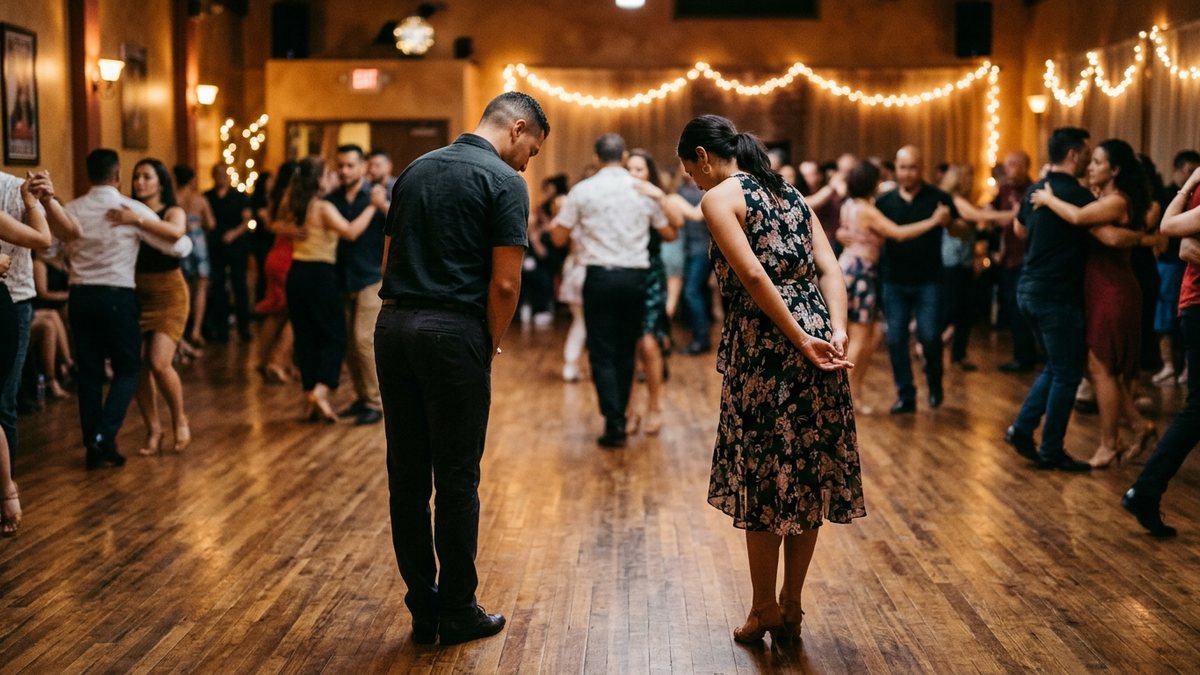
Images on this site are AI-generated illustrations, not photographs of real people, places or events.
Spotted something unnatural or wrong? Please tell us through the correction form (the form is in Japanese, but you can write in English).
The short answer: for both greetings and personal space, it is safest to think, “match the other person in the moment” (my suggestion). Hugs and beso (a greeting where cheeks touch) are said to be everyday greetings in Latin cultures, but they differ by country, region and relationship. I found no source saying you must do them at a party in Japan. If you are not comfortable with them, you do not have to do them. That is my view.
About this article
I live in Sapporo and am around 50 years old. In 2019 I discovered salsa and bachata, and I still dance today. I am not good at dancing, and I am not a teacher or an organizer. For facts, I stick to what I could confirm in public sources. The example phrases that start with “for example,” and the parts where I say “it is safe to…” or “it helps to think…” are my own suggestions. They are not anyone’s personal story.
The basics of asking and saying no are in How to Ask for a Dance and Say No: Social Dance Etiquette, and the flow of a whole day is in Your First Latin Dance Social: What to Expect from Arrival to Going Home. This article focuses on the background of greeting cultures, and on what to do in practice in Japan.
Greetings in Latin Countries: The Hug (abrazo) and the Beso
In Spanish-speaking countries, a hug is called an “abrazo,” and a greeting where cheeks touch is called a “beso.” In Brazilian Portuguese, a kiss or cheek greeting is a “beijo,” which is a different word from the Spanish one. People often think, “Everyone in Latin countries touches cheeks,” but the sources show a range.
- Latin America in general: According to Wikipedia’s “Cheek kissing,” a kiss on the cheek is a widely seen custom in Latin America as a greeting between men and women and between women. (For men with men, it says that in Argentina, Chile and Uruguay it is “common, but varies by region, setting and family.”) There are two forms: pressing the lips to the cheek, and touching cheeks and kissing the air. The second is reported to be more common
- Spain: According to The Cultural Atlas, in casual settings people kiss on both cheeks, starting “from the left” (it does not say whose left). This is especially common among women, and in work settings a handshake is said to be appropriate
- Argentina: According to The Cultural Atlas, in many regions there is one kiss, on the right cheek between friends who are not very close. Among friends and family, the most common greeting is said to be the abrazo, which combines a handshake and an embrace. When meeting for the first time or in formal settings, a handshake and a light nod are the basics
- Mexico: According to The Cultural Atlas, a handshake is said to be appropriate in most settings, and as people get closer, an abrazo, a loose embrace with a kiss on the right cheek, is preferred. In towns with many Indigenous people, greetings can differ. For example, in many towns in the state of Oaxaca, a loose handshake is expected (no kisses or embraces), and physical contact with people outside the family is described as not very common
- Colombia: According to The Cultural Atlas, a handshake is said to be appropriate in most settings, and as people get closer, women prefer a kiss on the right cheek with each other, and men prefer a hug with light taps on the shoulder or elbow
- Brazil (beijo): According to Babbel, the number of cheek kisses averages two, with three in some regions, and one in São Paulo. It differs by region, so I cannot give a fixed number
What we can see from this is that people do not always touch cheeks at a first meeting, and that even in the same country it differs by region, relationship and the genders of the two people.
Wikipedia also has a passage, in substance, saying that in regions where cheek kissing is customary, not accepting it or not doing it is easily taken as a sign of ill feeling toward the other person. But this is a general description of regions where the custom exists, and it does not simply apply to parties in Japan. Babbel’s explanation recommends matching the other person with cheek kisses, and not starting one yourself if the other person does not.
What Parties in Japan Are Really Like
According to The Cultural Atlas page on Japan, the most common greeting gesture in Japan is the bow, and many people also accept a handshake when meeting foreigners. This page has no description of hugs or cheek kisses, and it does not say they are common or uncommon. I also could not find a public source that explains “greeting manners” at Latin dance parties in the range I checked. In the sources I checked this time, I could not tell how common hugs and beso are at parties in Japan.
From here on, this is not confirmed fact. It is my own way of sorting things out (a suggestion), about how to think so you have fewer problems.
- Don’t bring Latin habits straight into a first meeting in Japan. If you suddenly hug or beso someone you have just met, some people will be taken aback
- Even if others do it, you don’t have to copy. A beginner does not need to match the greetings between people who are close
- It is easier to think of closeness in steps. Think of the order: a nod or a wave, a handshake, a hug, a beso, getting closer each time. If the other person goes up a step, you accept it. If they don’t, you stay where you are. That is enough. When you go up a step yourself, it is safest to ask in a few words first
Personal Space and Consent
When you dance as a pair, your bodies get close. Especially in dances where the distance is close, such as bachata, kizomba and Argentine tango, it is easier to think that how close the hold is gets decided by agreement with your partner, just like a greeting (my own way of sorting it out).
Published codes of conduct and guidelines show a way of thinking that values consent and personal boundaries.
- According to the code of conduct of the New York International Salsa Congress, consent is given clearly and can be withdrawn at any time. It also asks you to speak to the person before you dance, and to accept “no” as a final answer (updated May 2025)
- According to the “Safer Spaces” page of the Philadelphia Argentine Tango School, you may turn down a dance or activity without explaining why, and any dancer may ask for a more open hold. It also says that when someone asks you to stop, you listen respectfully and follow right away
- The code of conduct of the Brazilian Zouk Dance Council puts forward clear, active consent and respect for personal boundaries
- A paper by Juliet McMains of the Department of Dance at the University of Washington (Journal of Dance Education, published online in 2021) aims to make it normal, in social dance settings, to talk openly in advance about personal boundaries
These are the policies of overseas groups, so they do not necessarily apply to groups in Sapporo as they are. Also, what each source covers is different. It is the Philadelphia guideline that clearly says “you may decline without giving a reason,” and the New York code that clearly says “you can withdraw consent at any time.” Putting them side by side, I sorted it out like this: the idea that “you may ask,” “you may say no,” and “you may change midway” appears in several sources. Ideas for when sweat or smell bothers you are in Taking Care of Your Body on Latin Dance Days, and the basics of the roles are in What Are Lead and Follow? A Beginner’s Guide to the Roles in Latin Partner Dancing.
When You’re Not Comfortable, When You Say No, and When You’re Told No
The wording and example phrases in this section are my suggestions, based on the guidelines above (especially the Philadelphia guideline).
When you are not comfortable with greetings. It is not strange to be uncomfortable with hugs or cheek greetings. I think you don’t need to explain why. For example, you can say, “A handshake today, please,” or “I’m not good with hugs, so I’ll just wave.” If that is hard to say, you can also nod and hold out your hand.
When you decline a dance. You don’t need a reason (the Philadelphia guideline also says you may decline without giving a reason). For example: “Thank you, I’m resting now,” or “Sorry, I’ll pass today.” Say “Maybe next time” only when you really mean to dance with them. That way you don’t give the other person false hope.
When someone declines you. The reasons are many: health, mood, how the song suits them. For example, say, “I understand, thank you,” and move away right away. It is safer for both of you not to ask the reason and not to ask the same person again and again.
When you feel uncomfortable while dancing. It is fine to stop even in the middle of a song (the New York code says consent can be withdrawn at any time). For example, say, “It hurts here, so I’ll stop,” or “I’ll step back a little.” If that is hard to say, you can say “Thank you” at the end of the song and move away, and tell the organizer afterward. If the other person asks you to stop, please do so on the spot.
What to Say Before and After a Dance (Examples)
All of these are examples. Change them into words that are easy for you to say.
- Greeting: “Nice to meet you.” (with a nod) / “May I give you a hug?” / “Let’s just shake hands today.”
- Before dancing: “Would you like to dance?” / “It’s my first time, so could we go a little slowly?” / “I’m not comfortable with a close hold. Could we dance a little farther apart?”
- While dancing: “I’ll leave a little more space.” / “It hurts there, so I’ll stop.”
- After dancing: “Thank you.” / “That was fun.” (only when you really felt so)
It is safest to give advice only when you are asked (my suggestion).
What You Can Ask the Organizer
If someone’s behavior made you uncomfortable, I think you may tell the organizer, whether it happened at a greeting or in the middle of a dance. Of the sources I checked this time, New York and Philadelphia, which have codes of conduct or guidelines, point to people you can tell, such as staff or a contact person. The New York International Salsa Congress tells people to report right away to venue staff or a safety officer, and says there is also an online report form. The Philadelphia Argentine Tango School points to safety contact people, volunteers and a report form. On the code of conduct page of the Brazilian Zouk Dance Council, I did not find where to report.
I cannot tell from the sources I checked this time what the contact point or process is at groups in Sapporo. It differs by group, so before or on the day, try asking whom to talk to when you have a problem, and whether the group has decided anything about greetings and how close the hold should be. For rules on photos and videos, see Before You Take Photos or Videos at a Dance Party. For worries about going alone, see Can I Go to a Latin Dance Party Alone?, and for when you are too nervous to move, see Too Nervous to Dance at a Social?.
FAQ
If a stranger tries to hug me or beso me, do I have to accept?
No. I found no source saying you are obliged to accept. It is fine to hold out your hand and say, “Let’s just shake hands today,” or to answer with a nod (my suggestion).
Will they dislike me if I decline a hug?
Some people may be taken aback. Wikipedia also has a passage, in substance, saying that in regions where cheek kissing is customary, not doing it is easily taken as a sign of ill feeling. But the guideline of the Philadelphia Argentine Tango School says you may decline a dance or activity without giving a reason. I think it is better for both people to say what you don’t like than to keep dancing while putting up with it.
What if the other person is friendly and it is hard to say no?
I think a short “A handshake today” or “I’ll stop here” is enough. If you can’t say it, move away at the end of the song and talk to the organizer afterward.
How should I greet someone from another country when I dance with them?
There is no fixed form. If a handshake is offered, shake hands. If arms are opened for a hug, you may decide for yourself whether to accept. It is safest to watch what the other person does and match it (my suggestion; for cheek kisses, Babbel also recommends matching the other person).
What if I want to hug or beso someone myself?
It is safest to ask first: “May I give you a hug?” (my suggestion). If the other person hesitates even a little, smile and just nod.
Related articles
- How to Ask for a Dance and Say No: Social Dance Etiquette
- Your First Latin Dance Social: What to Expect from Arrival to Going Home
- What Are Lead and Follow? A Beginner’s Guide to the Roles in Latin Partner Dancing
- Latin Dance Glossary: SBK, Milonga, WS and More
- Latin Dancing in Sapporo: How to Start (Beginner Guide)
- Useful Phrases for Dance Socials: Basic Spanish, Portuguese and English
- Dance Hygiene and Etiquette: Sweat, Smell and Perfume, and What to Say If It Bothers You
You can also look up event dates on the Sapporo Latin Dance Calendar (札幌ラテンダンスカレンダー) (external site).
Sources
I checked the following pages, among others, on November 6, 2026.
- Wikipedia: Cheek kissing
- The Cultural Atlas: Spanish culture – Greetings
- The Cultural Atlas: Argentine culture – Greetings
- The Cultural Atlas: Mexican culture – Greetings
- The Cultural Atlas: Colombian culture – Greetings
- The Cultural Atlas: Japanese culture – Greetings (It describes only bowing and handshakes. It does not mention hugs or cheek kisses.)
- Babbel: How To Cheek Kiss In Different Parts Of The World
- New York International Salsa Congress: Code of Conduct
- Philadelphia Argentine Tango School: Safer Spaces
- Brazilian Zouk Dance Council: Code of Conduct
- University of Washington Department of Dance: Juliet McMains “Fostering a Culture of Consent in Social Dance Communities” (Journal of Dance Education, published online in 2021)
Where sources count differently, I give the range of what each source says. Overseas codes of conduct are each group’s own policy, and they do not necessarily apply to groups in Sapporo. If you find a mistake, please let me know through Contact (Japanese).