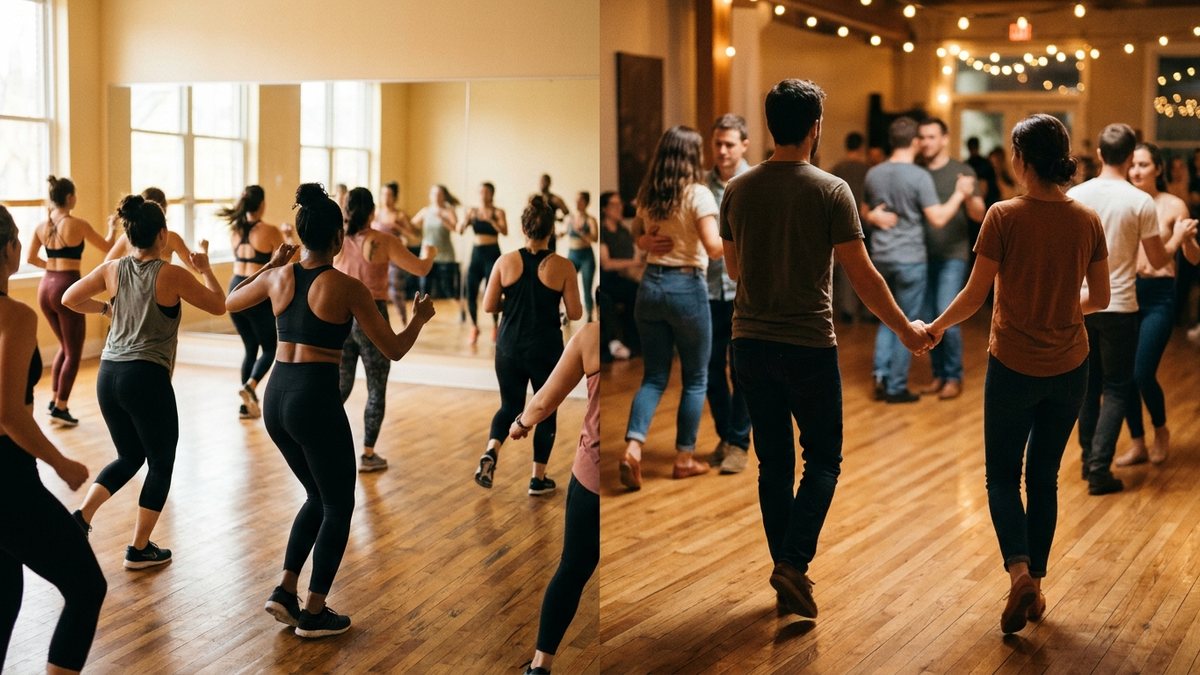
Ballroom & Competitive Dancing vs Salsa & Bachata: What's the Difference? Do You Need Experience?
Contents
- About this article
- Sorting Out the Words: Are Ballroom Dance, Competitive Dance and Social Dance the Same?
- What Is the “Latin” of Competitive Dancing?
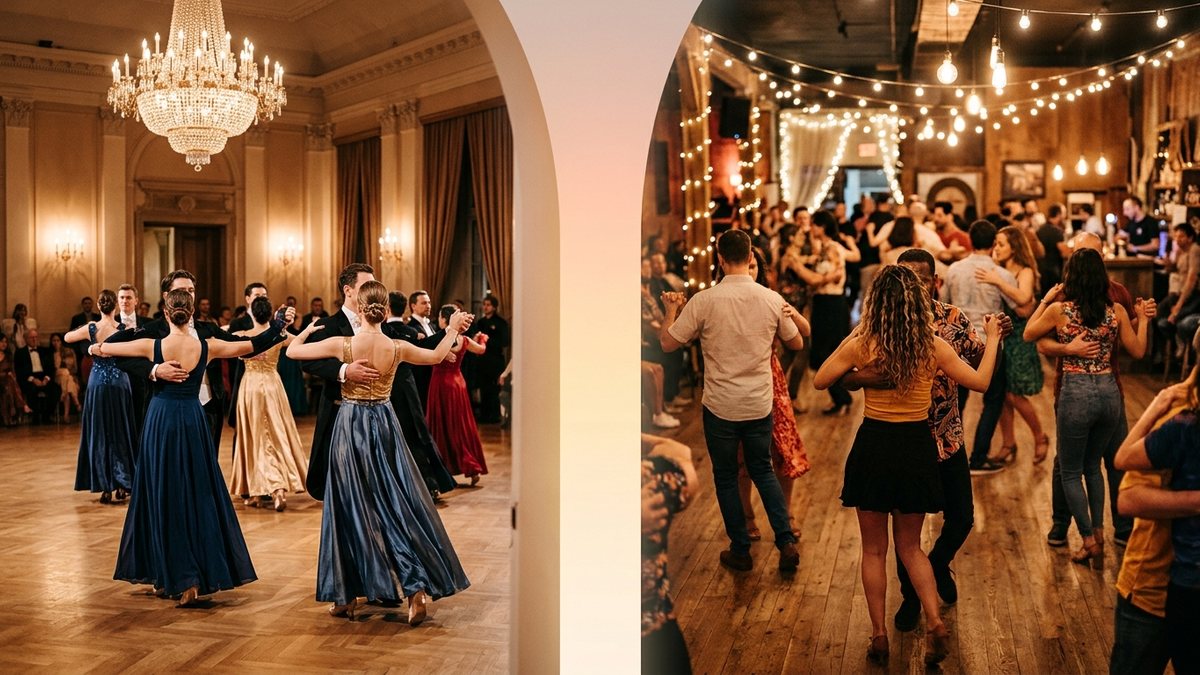
- How Is It Different from Salsa and Bachata?
- Salsa’s Roots Include Cha-cha-cha and Rumba
- Differences in Place: Classes, Parties and Competitions
- Do You Need Experience? How to Think About Starting
- Common Misunderstandings
- Related articles
- FAQ
- Sources I checked
This page is a reference translation of the Japanese original (日本語の原文). It has not been checked by a native speaker. Please confirm details with each organizer.
Images on this site are AI-generated illustrations, not photographs of real people, places or events.
Spotted something unnatural or wrong? Please tell us through the correction form (the form is in Japanese, but you can write in English).
The short answer: the “Latin” events of competitive ballroom dancing (rumba, cha-cha-cha and so on) and salsa and bachata are different things. Neither salsa nor bachata is among the 10 ballroom dances (Standard and Latin) listed by the Japan DanceSport Federation (JDSF). Still, both are dances in which two people dance to music, and they are connected by their roots in some ways. Whether you need experience is decided not by the type of dance but by the notice of each event. This article sorts out the points that cause confusion, checking them against sources.
- Ballroom dancing (shakō dance) is a word that broadly means “a dance in which a man and a woman form a pair and dance to music”
- Competitive dancing is built on ballroom dancing and has developed as a sport in which dancers compete for placings
- Salsa and bachata are partner dances to Latin music that people enjoy at parties. They are not among the 10 ballroom dances, but there are also salsa and bachata events in competition (see below)
About this article
I live in Sapporo and am around 50 years old. In 2019 I discovered salsa and bachata, and I still dance today. I am not good at dancing, and I am not a teacher. About ballroom dancing and competitive dancing, I write only what I could confirm in published dictionaries and organizations’ materials, and I show the source with “according to…”. Where I could not confirm something, I say so.
Sorting Out the Words: Are Ballroom Dance, Competitive Dance and Social Dance the Same?
There are many similar names, and many people get confused here.
| Word | What the sources say |
|---|---|
| Ballroom dancing (社交ダンス, shakō dance) | Digital Daijisen (デジタル大辞泉) explains it as “a dance in which a man and a woman form a pair and dance to music.” Nipponica (日本大百科全書) treats it as a translation of “social dance,” but says the term has now become obsolete worldwide |
| Ballroom dance (ボールルームダンス) | According to the World Encyclopedia (世界大百科事典), shakō dance was in the past also called “ballroom dance” (dancing in a ballroom) |
| Competitive dancing / DanceSport | The JDSF introduces DanceSport as “a competitive sport that is based on ballroom dancing, also called shakō dance, and has developed in its own way by pursuing its sporting side” |
| Social dance | In dictionaries, it is the English original of “shakō dance.” In Latin dance settings, it is a word often used for the format in which you change partners at a party (glossary) |
The last row is the confusing part. When you see it in a party notice, it is easy to understand it as “a format where you change partners on the spot” (my own way of sorting it out).
Some people say, “Salsa is a kind of ballroom dancing,” and others say, “It is a separate thing.” The Japanese-language Wikipedia says that salsa and Argentine tango are “generally not included in ballroom dancing.” It is less that one side is wrong, and more that people draw the edge of the word in different places.
What Is the “Latin” of Competitive Dancing?
Competitive dancing is roughly divided into two sections: Standard and Latin. According to the JDSF, the ballroom dances are these 10.
| Section | Dances |
|---|---|
| Standard | Waltz, Tango, Viennese Waltz, Slow Foxtrot, Quickstep |
| Latin | Samba, Cha-cha-cha, Rumba, Paso Doble, Jive |
On how they are danced, Nipponica gives two features of Latin dances: “you can dance apart and freely,” and “you express the rhythm with the whole body, including the hands and head.” A news item from Tokyo Institute of Technology (now Institute of Science Tokyo) about a student competitive-dance meet also explains that in Standard, a man and a woman dance as a pair, while in Latin American, a man and a woman basically dance apart.
According to the English-language Wikipedia, the origins of each “Latin” dance are as follows.
| Dance | Origin (according to English-language Wikipedia) |
|---|---|
| Rumba | A dance for the ballroom built on Cuban son and bolero. It is said to take in very few elements of the folk rumba of Cuba |
| Cha-cha-cha | Said to have been created in the early 1950s by Enrique Jorrín as a slow form of mambo. It was originally called “triple mambo” |
| Samba | The rhythm and the name come from the languages and cultures of enslaved people from West Africa. It is said to be built on Maxixe, an early Brazilian form, and is different from today’s Brazilian samba |
| Paso Doble | Began in Spain, inspired by bullfighting. It is danced in competition far more than in social settings |
| Jive | Born in the early 1940s in African American clubs in the US. US soldiers brought it to Britain during World War II, and it was shaped for competition in Britain |
So the competitive “Latin” also includes dances that were not born in Latin America, such as jive. The same source says that Latin music is generally the music of modern Latin America, and that only jive is said to use Western music. If you see the name “Latin” and think it is in the same group as salsa, this is where the mismatch comes from.
How Is It Different from Salsa and Bachata?
I sum up the differences in a table, within the range of general explanations.
| Item | Competitive Latin dances | Salsa and bachata (Latin dances danced at parties) |
|---|---|---|
| Purpose | To be given a placing by judges at a competition | To enjoy the music and meet people by dancing |
| Dances | 5 of the 10 dances listed by the JDSF | Divided by dance (compare the 4) |
| Music | The tempo is fixed for each dance. The tunes for a competition are said to be kept secret until the competition | A DJ chooses the songs. Speed and mood differ from song to song |
| Partner | Entering as a couple is the basic form | At a party, it is common to change partners |
| How you are seen | Judged on technique, timing, musical expression and so on | At a party, nobody gives placings |
| Place | Competitions, practice sessions, classes | Parties, lessons, workshops (differences) |
According to Nipponica, in competition five things are judged: basic rhythm and timing, style and harmony, movement, musical expression, and accurate technique. This seems to be a different kind of demand from a party, where the DJ plays one song after another at different speeds.
Also, the explanation above that “a man and a woman form a pair” is how the competition sources write it. In Latin dance settings, lead and follow are explained as roles that anyone can take, regardless of gender.
Are there salsa and bachata competitions too? A May 2026 press release from the JDSF says that DanceSport in the wider sense also includes “Caribbean DanceSport (salsa, bachata events and others),” and that the World DanceSport Federation (WDSF) sets the competition rules. This means they are not among the 10 ballroom dances. I have not checked what these competitions are like.
Salsa’s Roots Include Cha-cha-cha and Rumba
According to the English-language Wikipedia article on salsa, salsa is said to have grown out of Afro-Cuban dances such as son, danzón, mambo, cha-cha-cha and rumba. The Palladium Ballroom in New York is said to be one of the venues that spread Latin music and dance in the 1940s and 1950s.
Competitive cha-cha-cha and rumba and salsa are connected to the same music culture. But the road split into one shaped for competition and one danced at parties, and they are not the same dance.
Differences in Place: Classes, Parties and Competitions
In Japan, the places for ballroom dancing have changed over history. According to the World Encyclopedia on Kotobank, it grew popular after the Rokumeikan was built in 1883, and was enjoyed by the upper class. According to Nipponica, in 1918 a dance salon with a house band opened at the Kagetsuen Shokudo in Tsurumi, Yokohama, and this is said to be the start of professional dance halls. During the war, dance halls and training schools across the country were closed, and after the war, more enthusiasts formed circles in community centers and gymnasiums in many places.
On the legal side, according to a notification from the National Police Agency (June 24, 2015), one part of the revised Act on Control and Improvement of Amusement Business (Fūeihō, Act No. 45 of 2015), promulgated the same day, took effect on the day of promulgation. This is the provision that removes dance hall businesses from the businesses regulated as amusement businesses. However, a business that serves alcohol late at night and lets customers enjoy entertainment may fall under a separate license (tokutei yūkō inshokuten eigyō, a license category for businesses that serve alcohol late at night and let customers enjoy entertainment). Which place falls under which depends on how the business operates, so if you are unsure, ask the organizer or the police station.
On the competition side, according to the Japanese-language Wikipedia, Latin events were officially added to the All Japan Championships in 1963. At a competition, several couples dance on the same floor at the same time, and the final is explained as a system in which judges give placings (the Skating System).
On salsa, the Japanese-language Wikipedia explains that it began to take hold in Japan from the late 1990s, and that, through the Latin connection, bachata and others also became popular. How to look for parties and lessons in Sapporo is in How to Find Salsa, Bachata & Latin Dance Classes in Sapporo, and the kinds of events are in Party, Lesson or Workshop?.
Do You Need Experience? How to Think About Starting
To the question “Without ballroom dance experience, is salsa or bachata impossible?” the answer is “whether experience is required is something you check in the event’s notice.” From here on, this is not from the sources. It is this site’s own way of sorting things out (my suggestion).
If you have no experience - Look for whether the notice says “beginners welcome.” If it does not, tell the organizer “It’s my first time” and ask - Start with watching or a trial lesson. The flow is in Your First Latin Dance Lesson: What Happens from Check-in to Changing Partners - If you can’t decide between salsa and bachata, see the article on the differences
If you have ballroom or competitive dance experience - Whether your experience carries over directly depends on the person. This is my guess, but from the differences above, here are points where you may feel unsure - Songs: Unlike competition, where the tempo is fixed for each dance, at a party each song differs in speed and mood - Partners: In some formats, you dance with a different person every song. If you feel hesitant, see Too Nervous to Dance at a Social? - Terms: Words such as salsa’s On1 and On2 can differ by school (What Is Salsa?) - Matching the school’s way of doing things is the surest
Common Misunderstandings
“If it has ‘Latin’ in the name, competitive Latin and salsa are in the same group.” → In competition, “Latin” is the name of a section. It also includes dances that were not born in Latin America, such as jive.
“If I have rumba experience, salsa is the same.” → Competition rumba and Cuban rumba are said to be different things, and salsa is yet another dance.
“Argentine tango is ballroom dancing too.” → The Japanese-language Wikipedia says it is generally not included in ballroom dancing. For more, see Argentine Tango and Milonga: Basics Before Your First Milonga in Sapporo.
Related articles
- Latin Dancing in Sapporo: How to Start (Beginner Guide)
- History of Salsa: From Cuban Music to New York and the World
- Salsa, Bachata, Kizomba or Tango? Choosing a Dance in Sapporo
- Latin Dance Glossary: SBK, Milonga, WS and More
FAQ
Are competitive Latin dances and salsa the same?
They are different things. Salsa and bachata are not among the 10 ballroom dances (Standard and Latin) listed by the JDSF. But Cuban dances such as cha-cha-cha and rumba are said to be among the roots of salsa. They took a different road from the dances refined for competition.
Can I go to a salsa lesson if I haven’t learned ballroom dancing?
It is not always required. The conditions differ by school and organizer, so read the notice, and ask if it is unclear.
Can someone with competitive dance experience dance at a salsa party?
It depends on the person and the place. It is my guess that the points where people may feel unsure are that the tempo differs by song and that the partner changes with each song. Try matching the school’s way of doing things first.
Can you recommend a teacher or school?
This site does not recommend any specific school or group. Watching or trying a lesson to see whether it suits you is the quickest way.
Sources I checked
I checked the following pages in November 2026.
- Kotobank (コトバンク) “社交ダンス” (ballroom dancing) (Digital Daijisen, Nipponica, World Encyclopedia New Edition and others)
- Japan DanceSport Federation (JDSF) press release, May 11, 2026 (PR TIMES)
- Tokyo Institute of Technology (now Institute of Science Tokyo) news, 2016
- National Police Agency notification “風俗営業等の規制及び業務の適正化等に関する法律の一部を改正する法律の一部の施行等について” (Keisatsuchō Hei-Ho Hatsu No. 23, June 24, 2015)
- e-Gov法令検索「風俗営業等の規制及び業務の適正化等に関する法律」(特定遊興飲食店営業の定義は第2条第11項) (Japanese)
- Wikipedia: Ballroom dance
- Wikipedia: DanceSport
- Wikipedia: Salsa (dance)
- Wikipedia (Japanese): 競技ダンス (competitive dancing)
- Wikipedia (Japanese): 社交ダンス (ballroom dancing)
Wikipedia entries have weaker backing in places than dictionaries and the like, so I use them as a supplement. Where sources differ in wording or classification, I give the range of what each source says. If you find a mistake, please let me know through Contact (Japanese).