What Is Merengue (Music and Dance of the Dominican Republic)? Music, Basic Movement and How It Differs from Bachata
Contents
This page is a reference translation of the Japanese original (日本語の原文). It has not been checked by a native speaker. Please confirm details with each organizer.
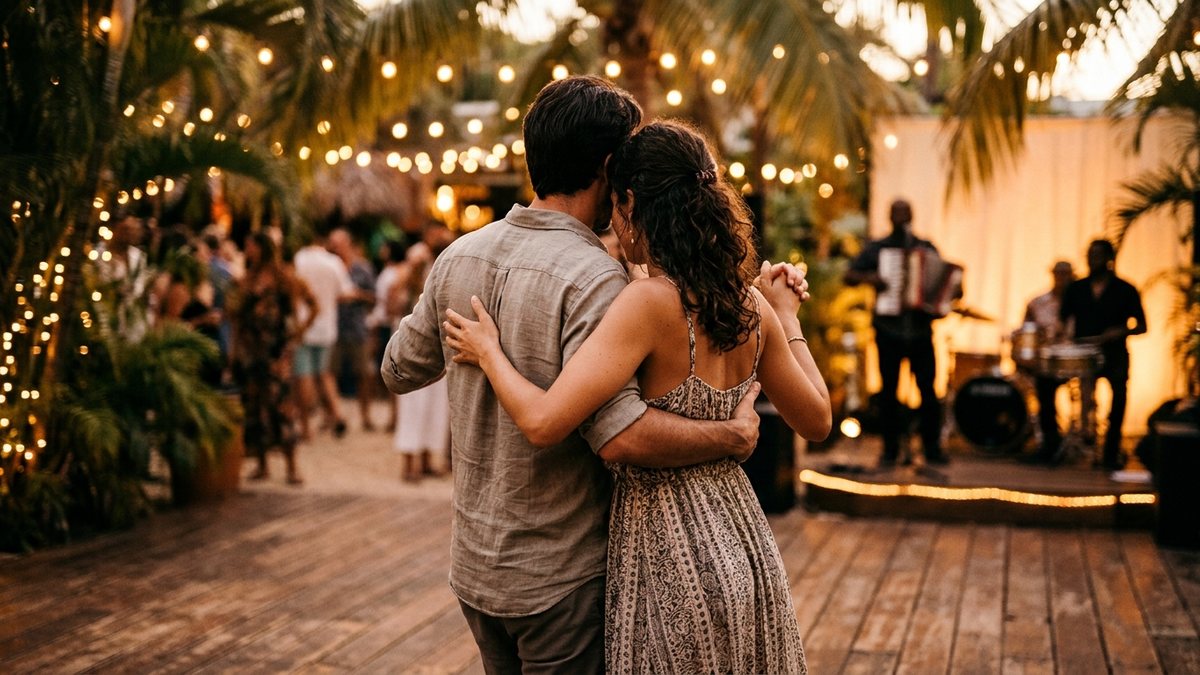
Images on this site are AI-generated illustrations, not photographs of real people, places or events.
Spotted something unnatural or wrong? Please tell us through the correction form (the form is in Japanese, but you can write in English).
The short answer: merengue is music and dance from the Dominican Republic. In UNESCO’s intangible cultural heritage entry, it is described as a dance performed in pairs, with the dancers moving in a circle. As for the music, according to the Japanese-language Wikipedia, it is fast music in a basic two-beat rhythm, centered on the accordion, the tambora (a double-headed drum), the güira (a metal scraper) and similar instruments. Bachata is a different music and dance, centered on the sound of the guitar, and it differs from merengue both in music and in how the steps are counted. In this article I sort out what could be confirmed in sources, and I write how beginners might think about taking part separately, as “my suggestion.”
- Merengue: The national music and dance of the Dominican Republic. Inscribed on UNESCO’s intangible cultural heritage list in 2016 (UNESCO)
- Music: Fast music in two beats. The accordion, tambora and güira are central (Japanese-language and English-language Wikipedia)
- How it is danced: The pair holds each other, bends and straightens the knees lightly to move the hips from side to side, and walks sideways or turns in small steps (English-language Wikipedia)
- Difference from bachata: The central instruments and how the steps are counted differ. I compare them in a table
About this article
I live in Sapporo and am around 50 years old. In 2019 I discovered salsa and bachata, and I still dance today. I am not good at dancing, and I am not a teacher or an organizer. I do not write a personal story about merengue. This article writes only what could be confirmed in publicly available sources, and shows the sources. The parts marked “my summary” and “my suggestion” are my thinking on this site, not what the sources explain and not anyone’s personal story. Where I could not confirm something, I say so. The date I checked was November 7, 2026.
What Is Merengue? UNESCO’s Explanation
The UNESCO intangible cultural heritage entry (“Music and dance of the merengue in the Dominican Republic”) was inscribed on the Representative List in 2016. The main points of its explanation are as follows.
- It is danced in pairs, and the participants move in a circle. Flirtatious gestures are used, to music played on the accordion, drums, saxophone and so on
- It is part of the national identity of the Dominican Republic, and appears in education, social settings, celebrations and even political movements. The UNESCO entry says that a presidential decree in 2005 recognized it, and November 26 was declared “National Merengue Day”
- The north is considered the birthplace. Its influence has reached Puerto Rico, the United States and the Caribbean region, and variations have also arisen in Venezuela and Colombia
- Learners often come into contact with the dance from a young age. The skills are passed on through “observation, participation and imitation”
- It is said to attract people from different social classes, and to promote respect and coexistence among people and groups
The decision of the Intergovernmental Committee that made the inscription (11.COM 10.B.9) contains an explanation to the same effect. Under criterion R.2 in the decision text, it says that the nomination file shows that merengue reflects European and African roots, and that it is enjoyed across social and regional lines. Also, the Dominican newspaper Diario Libre writes the law that set November 26 as “National Merengue Day” as “decreto 619-06,” and from the sources I checked I could not tell whether that matches UNESCO’s “2005.” The details of UNESCO’s entry will be put together in the article UNESCO Intangible Cultural Heritage and Latin Music and Dance.
Origins (There Are Several Theories)
The origin of merengue has not been settled as a single account. I separate what could be confirmed in sources, by where each statement comes from.
- Time and place: The English-language Wikipedia explains that it was first mentioned in the Cibao region of the north in the mid-19th century, and that the oldest record is a newspaper article. An article in the Dominican newspaper Diario Libre (2025), citing the book “Merengueros” by the journalist Fausto Polanco, writes that merengue was born before the revolution of 1844. It then explains that the only known written record is an article in the weekly El Oasis of November 26, 1854, which discussed this rhythm in a disparaging way, and that this later led, decades on, to the law setting November 26 as National Merengue Day
- Origin of the name: The Japanese-language Wikipedia says that there are several theories about the etymology, and lists these: from the European confection “meringue” (merengue), from words relating to West African dance and music, and from the language of the Taíno, the island’s indigenous people. The English-language edition lists two: from the confection, and from an indigenous word. None is decisive, and I cannot state any as fact
- Legends: The page of the US dance school Atomic Ballroom introduces a story that it began by imitating the walk of a war hero who had hurt his leg, while writing that “the origin is not well documented.” The dance information site Salsa Vida treats this “dragging a leg” story as folklore, and writes that the theory that it was danced on the battlefield at the time of independence in 1844 is a “myth.” Neither treats the legend as a certain origin
- Course of history: The Japanese-language Wikipedia explains that the basic form of the güira and tambora took shape in the mid-19th century, and that later a folk merengue with a fast tempo, with the accordion and other instruments added, appeared. The English-language Wikipedia says the accordion came to the island in the 1880s, brought by German merchants, and quickly became the leading instrument (there is no footnote source for this sentence. It is Wikipedia’s description)
- The Trujillo regime: The Japanese-language Wikipedia writes that it was used for political propaganda in the era of the dictator Trujillo, and the English-language edition writes that Trujillo imposed merengue on all classes, and also that he promoted it for political benefit
Note also that this page of the Japanese-language Wikipedia has “citation needed” notes in places. Please read the years and the course of events as a range.
Features of the Music
The features that could be confirmed in sources are as follows.
- Meter and tempo: The Japanese-language Wikipedia writes that Dominican merengue is basically a simple rhythm in two beats, “fast 2-beat music.” The English-language Wikipedia also explains that merengue is in 2/4 and is a “fast” arrangement. I did not find BPM (beats per minute) figures in the sources I checked. Note also that the English-language Wikipedia article on the dance gives the meter as 4/4 in its infobox, so the way it is written differs among sources
- Instruments: The Japanese-language Wikipedia says that the accordion, bass guitar, güira and tambora are central, and that the piano, saxophone, trumpet, guitar, conga and others are also used. According to the English-language Wikipedia, the tambora is a double-headed drum (one side struck with a stick, the other with the hand), the güira is a metal scraper, and the accordion is the star of folk “merengue típico.” Note that the instruments UNESCO’s entry lists are the accordion, drums and saxophone
- Styles: The English-language Wikipedia touches on styles such as the accordion-centered folk “merengue típico” (perico ripiao) and the big-band “orquesta.” It also writes that “pambiche” is a similar variation that is usually slower
- Rhythmic pattern: The English-language Wikipedia lists “quintillo” as a characteristic rhythm that is traditional (and that some consider fundamental). It writes that purists held that without it a piece is not true merengue, but that this view gradually faded as other patterns also came into use
There are also clues to the roles of the instruments and how to listen in Latin Dance Instruments and Rhythm Basics.
Basic Movement
The English-language Wikipedia’s explanation of the dance is as follows.
- The hold is explained as a closed position, with the pair facing each other. The lead holds the follow’s hip and hand
- The two bend and straighten their knees lightly from side to side. This moves the hips from side to side, and the two partners’ hips move in the same direction throughout the song. It is also described as a “danced walk”
- Most of the weight stays on the same foot. They walk sideways or turn around each other in small steps. The upper body stays steady
- Even when the music is fast, the turns are slow, and it is common for one full turn to take 4 beats (4 steps)
- There is also a form in which the hold is opened and each person turns while still holding hands
The Japanese-language Wikipedia explains that you “repeat a 2-beat step to fast 2-beat music,” that the basic movement is side to side, and that forward movement is sometimes included. It also writes that salsa and merengue used to be danced with the man and woman in close contact, but that this has been changing in recent years. I could not confirm this point in other sources.
The dance information site Salsa Vida explains the basic step of merengue as a steady “1-2-3-4” count, with a step usually taken on every beat, as a simple sideways movement or a marching-like step. The same page also says that because you keep stepping, it can be more tiring than you might expect. The dance school introduction page Atomic Ballroom also explains a two-beat rhythm, that most turns take 4 beats, that the upper body stays calm, and that the hips move through the bending and straightening of the knees, which overlaps with the content of the English-language Wikipedia.
Ways of counting and teaching can differ by teacher and school. What I have written here is the general explanation in public sources. The basics of lead and follow are in What Are Lead and Follow?.
How It Differs from Bachata and Salsa (Table)
Points confirmed in sources are marked “source,” and this site’s own way of sorting things out is marked “my summary.” The details of how salsa is danced go beyond the range of the sources I checked, so I leave them to What Is Salsa?.
| Item | Merengue | Bachata | Salsa |
|---|---|---|---|
| Music | Two beats. The accordion, tambora and güira are central (source) | The usual lineup is lead guitar, rhythm guitar, bass, bongo and güira (English-language Wikipedia) | Uses percussion such as bongo, conga and timbales, and instruments such as the trumpet (English-language Wikipedia). The montuno rhythm is said to cycle once every 8 counts (same). The counting on this site is in a separate article |
| Tempo | Described as “fast.” I could not confirm a BPM figure (source) | I could not confirm a figure. The dance is said to have come to be danced to faster music (source) | Some sources write “160 to 220 BPM” (English-language Wikipedia) |
| Movement | Knees bend and straighten lightly and the hips move from side to side. Walking sideways, turning in small steps (source) | A sideways movement in 8 counts. Counts 1 to 3 are 3 steps to the side, and on 4 a hip check (a hip movement). Beginners are said to be fine with a tap or a light lift of the foot (source) | See the separate article on this site |
| Closeness | Explained as danced in a closed position (source). There is also a form with the hold opened (source) | Originally danced only in a closed position with the bodies in contact. Today there are open, semi-closed and closed (source) | Many movements turn at a distance (my summary) |
As my summary, thinking of merengue as “a walking-like dance, done in a held position, stepping about once per beat to a fast two-beat rhythm,” and of bachata as “a dance in which a hip or tap movement comes on the 4th beat within an 8-count cycle,” makes the difference easier to see. But this is this site’s own way of sorting out several sources side by side, and none of the sources says it in this way.
The basic movement of bachata is put together in What Is Bachata?. For a comparison of salsa and bachata, please see Salsa vs. Bachata.
Also, according to the English-language Wikipedia’s “Bachata (music),” elements of merengue mixed into bachata from the mid-1980s on, and in merengue-based bachata the percussionist uses the tambora instead of the bongo. It also says that in the 1980s a bachata-style merengue (guitar merengue) appeared. They are closely related as music from the same country, the Dominican Republic.
How Beginners Might Think About Taking Part (My Suggestion)
From here on, this is not the explanation in the sources but my suggestion on this site.
Start by listening to the song and counting The sources explain that merengue is in two beats and that you step on about every beat. First listen to a song and try counting the beats, and the difference from bachata and salsa songs becomes easier to see.
Start with small movements In the sources’ explanation, the steps are small and the upper body is steady. You do not need to move big. You can start by bending and straightening your knees lightly and walking sideways (my suggestion).
Change partners, and don’t push yourself Merengue is explained as being danced holding a partner. If the closeness feels too much, my view is that it is fine to ask your partner or the teacher about the distance.
Check whether merengue will be played at an event in Sapporo Information on events in Sapporo can be found on the Sapporo Latin Dance Calendar (札幌ラテンダンスカレンダー) (external site). Please check the organizer’s notice to see whether merengue songs will be played at an event. Salsa Vida writes that at socials specializing in salsa or bachata, merengue is often played only for a song or two, but this is a general explanation, not a statement about any group in Sapporo.
If you are unsure which dance to start with, Salsa, Bachata, Kizomba or Tango? Choosing a Dance in Sapporo may help.
FAQ
What is merengue?
It is music and dance from the Dominican Republic. In UNESCO’s intangible cultural heritage entry, it is explained as danced in pairs, with the dancers moving in a circle, and as part of the national identity. It was inscribed in 2016.
When and where was merengue born?
The English-language Wikipedia explains that it was first mentioned in the Cibao region of the north in the mid-19th century. The UNESCO entry also says that the north is considered the birthplace. However, accounts of the origin differ by source, and it has not been settled as one.
What are the features of merengue music?
According to the Japanese-language Wikipedia, it is fast music in a basic two-beat rhythm, centered on the accordion, bass guitar, güira and tambora. I did not find BPM figures in the sources I checked.
How do merengue and bachata differ?
The central instruments and how the steps are counted differ. The sources explain that bachata is a sideways movement in 8 counts, and that in merengue you step on about every beat to a two-beat rhythm. Please see the table.
Can I take part in merengue alone?
The sources explain that dancing as a pair holding each other is the general form. Whether you can take part alone was not written in the sources I checked. Please confirm in the event’s notice.
Is there a place in Sapporo where I can learn merengue?
I have not been able to confirm any facts about this, so this site does not introduce any. Information on events in Sapporo can be found on the Sapporo Latin Dance Calendar (札幌ラテンダンスカレンダー).
Related articles
- What Is Bachata? Music, Basic Steps and Styles
- Salsa vs. Bachata: Differences and Which to Start With
- What Is Salsa? Music, Rhythm and On1 / On2 / Cuban Styles
- Latin Dance Instruments and Rhythm Basics: Salsa, Bachata, Kizomba and Tango
- Salsa, Bachata, Kizomba or Tango? Choosing a Dance in Sapporo
Sources
I checked the following pages on November 7, 2026.
- UNESCO: Music and dance of the merengue in the Dominican Republic (inscribed 2016) (dancing in pairs, moving in a circle, instruments, National Merengue Day, birthplace)
- UNESCO: Decision of the Intergovernmental Committee 11.COM 10.B.9 (the decision on inscription, the description of the element, European and African roots)
- Wikipedia: メレンゲ (音楽) (Japanese-language edition) (theories of etymology, two beats, instruments, how it is danced)
- Wikipedia: Merengue music (English-language edition) (Cibao region, 2/4 meter, instruments, styles, pambiche, quintillo, Trujillo)
- Wikipedia: Merengue (dance) (English-language edition) (hold, basic movement, turns, meter 4/4 in the infobox)
- Wikipedia: Bachata (dance) (English-language edition) (basic movement in 8 counts, closeness)
- Wikipedia: Bachata (music) (English-language edition) (instrumentation, the mixing in of merengue elements, bachata-style merengue)
- Wikipedia: Salsa music (English-language edition) (8 counts of the montuno, 160 to 220 BPM, instruments)
- Diario Libre “Patrimonio Inmaterial de la Humanidad: Día Nacional del Merengue” (2025) (a Dominican newspaper. The only written record known [1854], law number 619-06)
- Salsa Vida: Merengue (Dance) (a dance information site. How to count the basic, how the origin legend is treated)
- Atomic Ballroom: Merengue (the introduction page of a US dance school. Two beats, turns, the origin legend)
For the points where I could find only Wikipedia as a basis (the BPM of salsa music, the instrumentation of bachata, the accordion having been brought by German merchants in the 1880s, and the mixing of merengue elements into bachata), the text gives the source as “according to Wikipedia.” I did not newly confirm the details of how salsa is danced this time.
The following pages could not be opened in this check (access denied, or no such page), and I did not use their contents as fact: the Britannica entry “Merengue,” the Smithsonian Folkways album notes on merengue, the official website of the Dominican Republic’s Ministry of Tourism (godominicanrepublic.com; I could not find a description of merengue), and the pages of the Dominican Republic’s Ministry of Culture. For this reason, the explanations of the Dominican Republic’s official tourism and culture agencies are not in the text. Where the way sources write it differs, I give a range. If you find a mistake, please let me know through Contact (Japanese).