What Age Can You Start Latin Dance? Starting in Your 20s to 60s and Over, and What to Watch For
Contents
- About this article
- Does age matter? What the materials can say, and what they cannot
- By age group: what the materials say, and my suggestions
- Strain on the body, and ways not to push yourself
- If you have a health condition or a worry
- Spending time where younger and older people mix
- Summary: 3 checks before you start
- Related articles
- FAQ
- Sources
This page is a reference translation of the Japanese original (日本語の原文). It has not been checked by a native speaker. Please confirm details with each organizer.
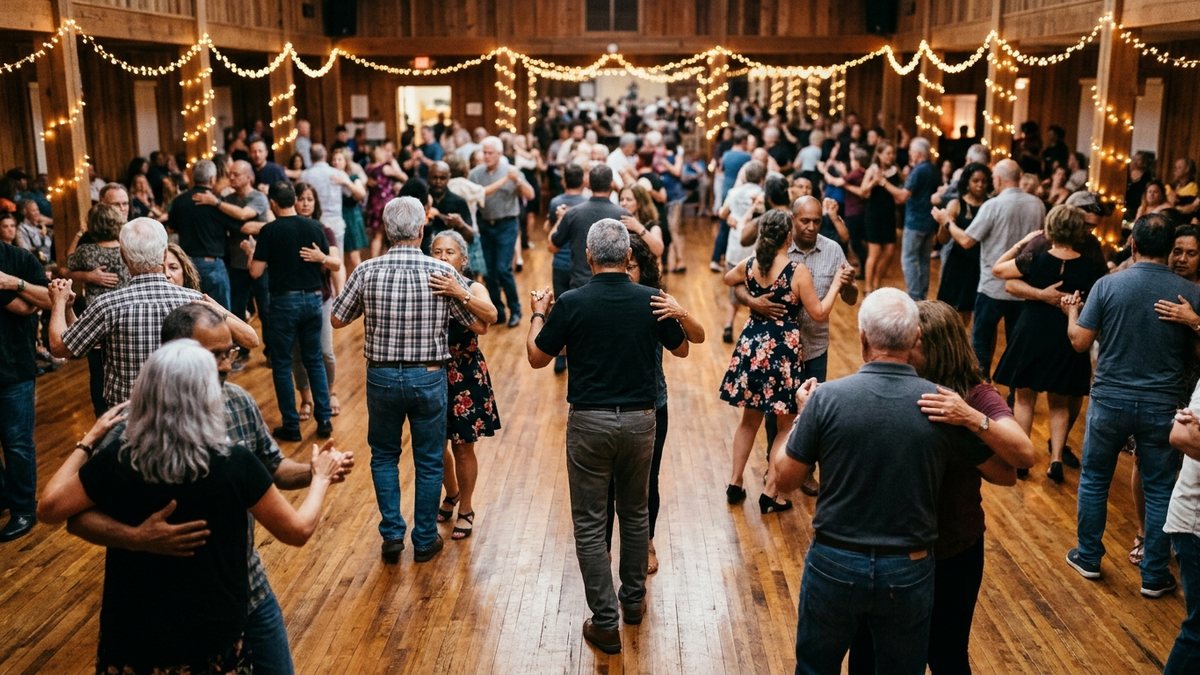
Images on this site are AI-generated illustrations, not photographs of real people, places or events.
Spotted something unnatural or wrong? Please tell us through the correction form (the form is in Japanese, but you can write in English).
The short answer: in the official materials I checked, I did not find any line saying “from what age” or “up to what age.” What the materials repeat is this idea: “take individual differences into account, adjust the intensity and amount, and start with what you can do.” For Latin dance too, I think it is better to start small to match your health and fitness today than to decide by age (my suggestion).
“I’m not young anymore.” “Everyone may be younger than me.” I think many people stop just before the first step for reasons like these. This article sorts the topic of age into what official materials can say and what they cannot.
About this article
I live in Sapporo and am around 50 years old. In 2019 I discovered salsa and bachata, and I still dance today. I am not a teacher or an organizer. I am not a doctor or a trainer either.
I am not an expert on the body, so I introduce what materials such as those of the Ministry of Health, Labour and Welfare and the Japan Sports Agency say, in the form “according to…”. My own views are marked “my suggestion” to keep them separate. This article does not talk about the effects of dance, or about preventing or treating any disease.
Does age matter? What the materials can say, and what they cannot
| Item | What the materials can say | What they cannot say |
|---|---|---|
| Age to start | The materials I checked did not give an upper or lower age limit for starting dance | Deciding “up to what age it is safe” or “from what age it is too late” |
| How to go about exercise | The Ministry of Health, Labour and Welfare guide says to take individual differences into account, adjust the intensity and amount, and start with what you can do | Deciding “this strength for this age group” |
| Moving a little | The same guide recommends moving your body even a little more than you do now | Whether dance meets the guide’s reference amounts (I have not been able to confirm this) |
Age may be one guide, but it does not seem to be a line that decides “can” or “cannot.” Please read the numbers below not as traits of an age group, but as material for thinking about what gets you started with exercise.
By age group: what the materials say, and my suggestions
20s, 30s, 40s and 50s: what the materials say
- According to the adult sheet of the Ministry of Health, Labour and Welfare’s “Physical Activity and Exercise Guide for Health Promotion 2023” (健康づくりのための身体活動・運動ガイド2023), adults are recommended to do physical activity at the intensity of walking or higher for at least 60 minutes a day (equal to about 8,000 steps or more). Muscle-strengthening exercise is recommended on 2 to 3 days a week. The guide also says to take care that you do not sit for too long. The materials cannot tell us whether dance counts as “the same intensity or higher”
- According to the Japan Sports Agency’s “FY2025 (Reiwa 7) Public Opinion Survey on Sports Participation” (survey conducted in November 2025 and published on March 11, 2026), the rate of adults aged 20 and over who play sports at least once a week is 51.7%. The rate is said to remain low among people in their 20s to 50s, the generations raising children and in their prime working years. It also reports that women in their 20s to 50s spend markedly little time on exercise and sports, only about 30 to 40 minutes a week
20s, 30s, 40s and 50s: my suggestions
- This overlaps with the generations that find it hard to make time for exercise because of work and housework. So you do not need to plan to go every week from the start. “Just watching” or “just one time” is enough at first
- If you have not exercised for a while, watch how tired you are after the first few times, and go at that pace
60s and over: what the materials say
- According to the older adults’ sheet of the same guide, older adults are recommended to do physical activity at the intensity of walking or higher for at least 40 minutes a day (equal to about 6,000 steps or more). Multi-component exercise that builds muscle strength, balance, flexibility and so on is recommended on 3 or more days a week. This sheet also has the sentence “take individual differences into account, adjust the intensity and amount, and start with what you can do.” The sheet did not say from what age a person counts as an older adult
- According to “Points for Doing Physical Activity and Exercise Safely” in the same guide, older adults need to take care because taking sleeping pills, blood pressure medicine and the like can cause falls. It also says that, depending on a chronic disease or the medicines you take, you need to take care when exercising, so before you start you should check your current condition and the medicines you are taking
60s and over: my suggestions
- Whether someone in their 60s should use the adult sheet or the older adults’ sheet as a guide, I think it is natural to choose by fitness and health, not by age. If you are unsure, talk to a doctor or other professional
- Partner dances include moves such as turning and stepping back. If you are not steady on your feet, it may help to tell the teacher or organizer at the start, because they may be able to take it into account (how they respond differs by organizer). For shoes, please also see What to Wear and Which Shoes for Latin Dance (Sapporo Winter Too)
Strain on the body, and ways not to push yourself
“Points for Doing Physical Activity and Exercise Safely” in the same guide says the following. The right-hand column is my suggestion for Latin dance.
| When | What the materials say | For Latin dance (my suggestion) |
|---|---|---|
| Before each time you exercise | Check your health and the weather. For exercise of some intensity, always warm up | Rest on days you feel unwell. If the lesson has a warm-up, use it to get your body used to moving |
| While exercising | Stop right away if you have chest pain, a racing heart, dizziness or unsteadiness, strong hunger or trembling hands and feet, unusual strong tiredness, strong pain in joints or muscles, a cold sweat, or similar | Stop on the spot and sit down. Tell your partner too. “I’ll rest a little” is enough |
| After exercising | Stopping exercise suddenly can cause a drop in blood pressure or an irregular heartbeat. Keep doing low- to moderate-intensity dynamic movement for about 5 to 10 minutes | Don’t sit down right after you finish dancing. Calm down slowly, for example by walking around the venue a little |
I have put tips for taking care of your body on a dance day in Taking Care of Your Body on Latin Dance Days: Sweat, Water, Tired Feet and Next-Day Care. If symptoms continue, please talk to a medical institution.
Here is one more idea, as a suggestion. At a party, you may be able to choose for yourself how many songs you dance. Resting when you are tired, or going home early, is also a choice (this differs by venue and organizer, so check the notice). Whatever your age, I think being able to cut back on your own makes it easier to keep going.
If you have a health condition or a worry
The Ministry of Health, Labour and Welfare’s “Points on Physical Activity for People with Chronic Diseases” says the following.
- If you have complications that physical activity could make worse, or pain or deformity in the musculoskeletal system, talk to a doctor or other professional first
- The sheet is aimed at people who have high blood pressure, type 2 diabetes, dyslipidemia or knee osteoarthritis and whose condition is stable. It describes it as important to first understand your current condition, start at an intensity and frequency that is not a strain, and increase them gradually
This site cannot diagnose or treat any disease, or decide whether you may exercise. People in the following situations should talk to their family doctor or similar before starting.
- People who are being treated for blood pressure, the heart, diabetes, joints and so on, or who take medicine
- People who have had chest pain, a racing heart or dizziness while exercising
- People who have not exercised for a while and are unsure about their fitness
When you talk to a doctor, I think it is easier for the doctor to answer if you say specifically what you want to do: “I want to do partner dance (standing, walking and turning) to music for about one to two hours at a time” (my suggestion).
Spending time where younger and older people mix
How the age groups mix at Latin dance parties and lessons differs from place to place, and it is not something I can generalize about. With that said, here are my suggestions.
- When you dance with someone younger. Greet them first and say “I’m a beginner.” If you talk about it as a difference in dance experience, not in age, it feels easier
- When you dance with someone older. Match their pace. Don’t pull hard or spin fast. The manners are the same whatever the age difference. For more, see What Are Lead and Follow? A Beginner’s Guide to the Roles in Latin Partner Dancing
- When you ask or say no. You can do it without giving age as the reason, for example “I’ll rest a little” or “I’d love to dance the next song.” I wrote about this in How to Ask for a Dance and Say No: Social Dance Etiquette
If you are curious about the age of the participants, you can ask to watch and decide after you see the atmosphere.
Summary: 3 checks before you start
- Check your health. If you have a health condition, take medicine or have worries, talk to a doctor or other professional first
- Start small. Watching, a trial, or just one time is enough
- Choose a place where you can rest. In the notice, check whether beginners are welcome, whether you can watch, and whether you can take breaks
Related articles
- Your First Latin Dance Lesson: What Happens from Check-in to Changing Partners
- Can I Go to a Latin Dance Party Alone? (Salsa, Bachata)
- Latin Dancing in Sapporo: How to Start (Beginner Guide)
- Latin Dance FAQ for Beginners: 22 Questions Before You Start in Sapporo
- Taking Care of Your Body on Latin Dance Days: Sweat, Water, Tired Feet and Next-Day Care
- How to Keep Up Latin Dance: Signs of Progress and What to Do When You’re Stuck
- Party, Lesson or Workshop? Latin Dance Events Explained
FAQ
What age can I start from?
The official materials I checked did not give a lower or upper age limit for starting dance. Some schools or events may have age rules, so check the notice.
Is it OK to start in my 60s or 70s?
It cannot be said “OK” or “not OK” by age alone. For older adults too, the Ministry of Health, Labour and Welfare’s Guide 2023 says to take individual differences into account, adjust the intensity and amount, and start with what you can do. If you have a health condition or take medicine, talk to a doctor or other professional before you start. Whether you can join is surest to ask the school or organizer.
Can I dance if I don’t get much exercise?
The same guide recommends moving your body even a little more than you do now. On your first day, it feels safe to start with watching or a short time, and to see how your body responds (my suggestion). If you are worried, talk to a doctor or other professional.
What if I start to feel unwell while dancing?
The same guide says to stop exercising right away if you have chest pain, a racing heart, dizziness and the like. Stop on the spot and sit down, and if needed, tell the people around you or the organizer. If symptoms continue, please talk to a medical institution.
Sources
I checked the following pages on November 6, 2026. The pages are in Japanese.
- Ministry of Health, Labour and Welfare (厚生労働省) e-Healthnet, “Physical Activity and Exercise Guide for Health Promotion 2023, Recommendation Sheet: Adults” (『健康づくりのための身体活動・運動ガイド2023』推奨シート:成人版)
- Same site, “Recommendation Sheet: Older Adults” (推奨シート:高齢者版)
- Same site, “Points on Physical Activity for People with Chronic Diseases” (慢性疾患を有する人の身体活動のポイント)
- Same site, “Points for Doing Physical Activity and Exercise Safely” (身体活動・運動を安全に行うためのポイント)
- Ministry of Health, Labour and Welfare, “Physical Activity and Exercise Guide for Health Promotion 2023,” main text PDF (「健康づくりのための身体活動・運動ガイド2023」本編PDF) (I could not read the whole text, so I checked the numbers in the recommendation sheets above)
- Japan Sports Agency (スポーツ庁), “Announcing the results of the FY2025 (Reiwa 7) Public Opinion Survey on Sports Participation” (令和7年度『スポーツの実施状況等に関する世論調査』の結果を公表します) (published March 11, 2026 [Reiwa 8])
- Japan Sports Agency, “FY2025 (Reiwa 7) Public Opinion Survey on Sports Participation (November 2025 survey)” (令和7年度『スポーツの実施状況等に関する世論調査』(令和7年11月調査)) (I checked how the survey period is written)