Getting to and from Latin Dance in Winter in Sapporo: Snowy Roads, Shoes, Warm Clothes and Getting Home After Drinking
Contents
- About this article
- How Cold Is Sapporo in Winter, and How Much Snow Is There?
- How Should You Walk on Snowy or Icy Roads?
- Where Is It Slippery? When Does It Freeze?
- How Should You Carry and Change Dance Shoes?
- How Should You Keep Warm After Sweating?
- How Should You Get Home from a Place Where People Drink?
- How Do You Check the Last Train and Other Ways Home?
- FAQ
- Related articles
- Sources
This page is a reference translation of the Japanese original (日本語の原文). It has not been checked by a native speaker. Please confirm details with each organizer.
Images on this site are AI-generated illustrations, not photographs of real people, places or events.
Spotted something unnatural or wrong? Please tell us through the correction form (the form is in Japanese, but you can write in English).
The short answer: when you go dancing in Sapporo in winter, keep four things in mind: “leave early,” “take small steps and walk with the whole sole of your foot down,” “knock the snow off your shoes before you go inside,” and “check how and when you will get home before you leave.” After that, you do not need to be too worried. That is my view (my suggestion). I found confirmable content in the City of Sapporo’s materials for how to walk on snowy roads, and in the Ministry of Health, Labour and Welfare’s guidelines for thinking about drinking at events.
About this article
I live in Sapporo and am around 50 years old. In 2019 I discovered salsa and bachata, and I still dance today. I am not good at dancing, and I am not a teacher or an organizer. For facts, I stick to what I could confirm in public sources. The ways of handling things that start with “for example,” and the parts where I say “it is safe to…” are my own suggestions. They are not anyone’s personal story. This article has no personal story, such as falling on a snowy road.
The basics of shoes and clothes are in What to Wear and Which Shoes for Latin Dance, and care for your body after dancing is in Taking Care of Your Body on Latin Dance Days. This article focuses on safety on the “way”: from leaving home, to arriving at the venue, to getting back home. I do not give medical advice or recommend specific shoes or products.
How Cold Is Sapporo in Winter, and How Much Snow Is There?
According to the Japan Meteorological Agency (気象庁) normal values for Sapporo (the observation point named “Sapporo”) for 1991 to 2020, they are as follows.
- Average temperature: December -0.9℃, January -3.2℃, February -2.7℃, March 1.1℃
- Average daily minimum temperature: December -4.0℃, January -6.4℃, February -6.2℃, March -2.4℃ (this is not the temperature at night itself)
- Total snowfall depth: December 113 cm, January 137 cm, February 116 cm, March 74 cm
- Maximum snow depth: December 47 cm, January 76 cm, February 95 cm, March 82 cm
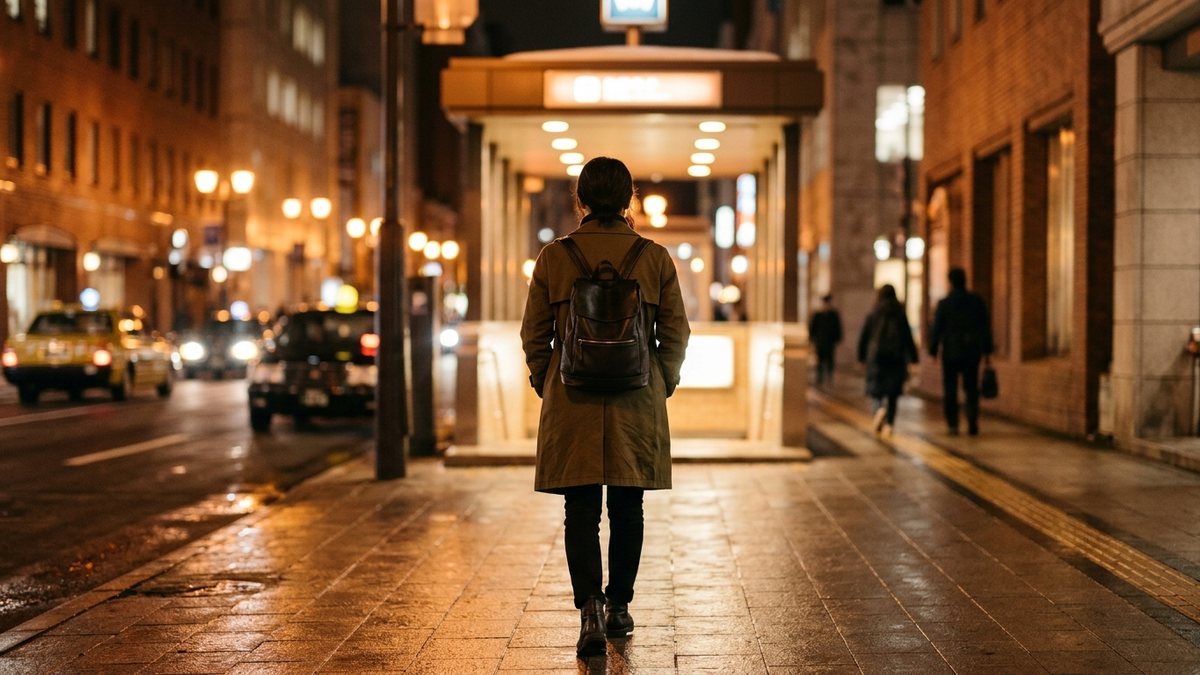
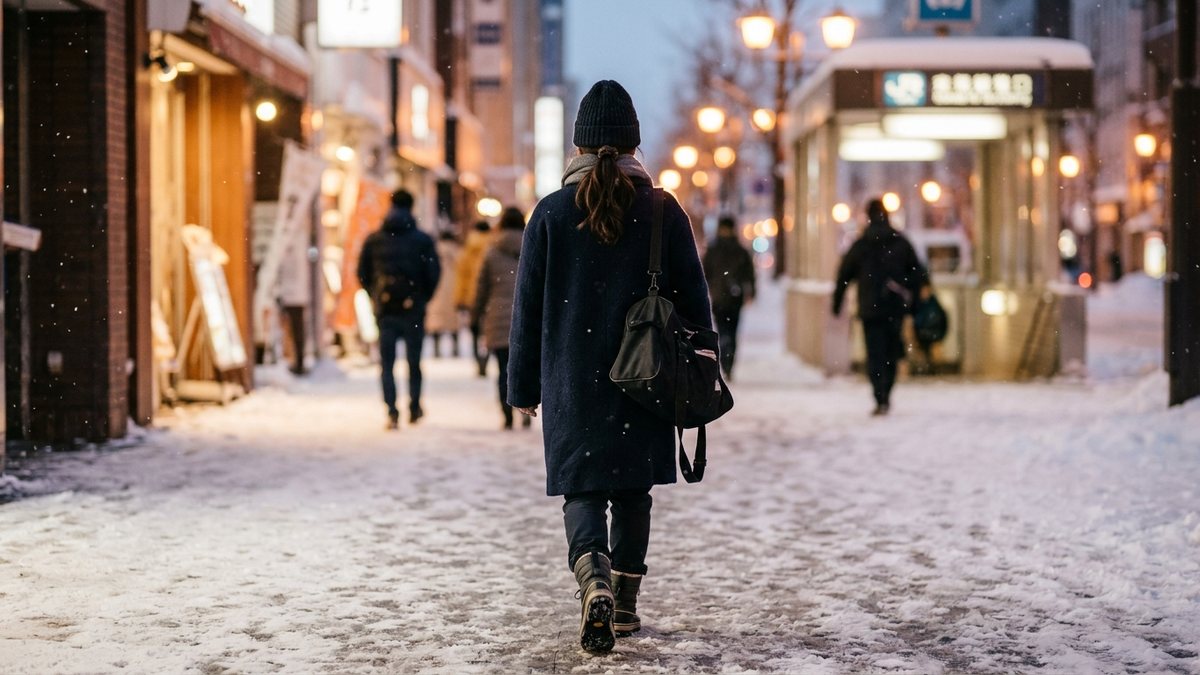
These are long-term averages, and they are different from the weather in any given year. From December to March, the average daily minimum is below freezing and snow piles up. You walk to and from the venue in it. The City of Sapporo’s page for tourists says that winter in Sapporo has icy road surfaces and heavy snow, and advises people to avoid going out on days when a snowstorm is forecast. Not going on a rough day is also a choice (my suggestion).
How Should You Walk on Snowy or Icy Roads?
The Sapporo City Fire Bureau (札幌市消防局) leaflet “雪道での転倒事故にご注意!” (Beware of falls on snowy roads!) and the City of Sapporo’s “雪道で転ばないコツ教えます!” (Tips for not falling on snowy roads) say the following.
- Take small steps. With big steps you have to lift your foot high, your center of gravity (the sway of your body) moves more, and you fall more easily. On slippery ground, take small steps as a rule. It is said to be better to keep your feet reasonably apart from side to side (around 20 cm)
- Walk with the whole sole of your shoe on the ground. Put your weight forward and try to keep the whole sole of your shoe on the road as much as you can
- On slick, icy surfaces (called “tsurutsuru” roads), a “suriashi” (shuffling) way of walking works well. Take small steps with the whole sole down. But if you scrape the ground completely as you walk, you can trip, so lift your feet lightly
- Do not rush, do not panic, and leave yourself room. Assume that getting around takes longer in winter than in summer, and set out early. When you have room to spare, it is easier to spot roads that look slippery. It is also said to be important to stay away from places that look dangerous
- Be careful about “walking while doing something else” (nagara-aruki). Your attention to your surroundings and the road surface tends to fade
A Weathernews article (published February 2026) introduces the explanations of Mr. Yasuhiro Kaneda (金田安弘) of the Winter Life Promotion Council (ウインターライフ推進協議会, Sapporo). It says that on icy roads you should not land on your heel but press down with the whole sole of your foot, carry your things on your back rather than in your hands so that both hands are free, and that you fall more easily when you change direction, start walking, or hurry.
On shoes, the City of Sapporo’s materials give three points for winter shoes: “does not slip,” “does not get wet” and “is warm.” They also say that a sole with deep grooves can still slip on slick roads if it is hard, and that softness matters too. I do not recommend any specific shoes.
Where Is It Slippery? When Does It Freeze?
The City of Sapporo’s materials list these as slippery places.
- Crosswalks: The road is packed down, and the tires of cars that were stopped wear the surface smooth when they start moving. The Weathernews article also says that a thin film of ice forms easily on the white lines
- Sidewalks where cars enter and leave, and places where people get on and off buses and taxis: The snow gets packed down and becomes slippery
- Entrances to underground shopping areas and shops: On tile floors, you can slip on the snow or water on the soles of your shoes. It is said to be important to get rid of the snow and water before you go in. Winter shoes with metal anti-slip studs can also be more slippery in such places
- Where road heating (heated pavement) ends: The Fire Bureau corner of the January 2023 issue of “Kōhō Sapporo” (the City of Sapporo’s public relations magazine) lists it as a place where people fall easily
The way home from dancing tends to be at night. A leaflet from the Takefu Labour Standards Inspection Office (武生労働基準監督署) of the Fukui Labour Bureau in Fukui Prefecture (it appears to be from around 2013) explains that snow and ice that melted during the day freeze again when the temperature drops in the evening or at night and turn into slick, icy surfaces, and that when fresh snow falls on top, they are hard to see. It is a Fukui Prefecture material, but the mechanism seems likely to apply to Sapporo too (my guess). The Winter Life Promotion Council’s page “転びにくい冬みちの歩き方” (How to walk on winter roads so you don’t fall) also introduces, as a comment from a resident in a video, that even when snow has piled up, the ground beneath it can be frozen.
The Sapporo City Fire Bureau page has a notice about the “Tsurutsuru Forecast” (つるつる予報), which predicts in 3 levels how slippery sidewalks will be between 7:00 and 10:00 the next morning (provided by the Winter Life Promotion Council). It is a morning forecast, so I could not tell from the sources I checked whether it applies as it is to the road surface at night.
How Should You Carry and Change Dance Shoes?
From here on, these are not confirmed facts. They are my suggestions for “how to handle it so you have fewer problems.”
As in What to Wear and Which Shoes for Latin Dance, in winter the usual assumption is that you change from outdoor shoes into indoor shoes or dance shoes, so you carry more. For example, it is easier to organize it like this.
- On the way home, take smaller steps than on the way there, and leave yourself room. After dancing, your feet may be tired (Taking Care of Your Body on Latin Dance Days)
- At the entrance to the venue, knock the snow off your shoes before you go in. As in the City of Sapporo’s materials above, snow and water on the soles can make you slip on a tile floor
- Change shoes where you can sit. It is steadier than changing on one foot while standing. If the venue has a place for changing shoes, follow that
- Keep outdoor shoes and dance shoes in separate bags. For example, you can put the outdoor shoes in a bag you already have and carry them separately. For how to handle dance shoes, asking the teacher or organizer is the surest
- Choose a bag that leaves both hands free. The City of Sapporo’s material (Kōhō Sapporo) lists not carrying things in your hands. Some people choose a bag they can wear on their back
How Should You Keep Warm After Sweating?
As I also wrote in Taking Care of Your Body on Latin Dance Days, dancing as a pair can make you sweat more than you expect, and staying sweaty can leave your body cold. In winter in Sapporo, the difference you feel between inside the venue and outside can be large. As my suggestions, here are some ideas.
- Before you leave, wipe off sweat, and change clothes if you can. The list of things to bring is in the article on shoes and clothes
- Put on your coat, gloves and scarf before you go outside. Right after you leave the venue is a time when it feels cold
- Do not walk with your hands in your pockets. The Fire Bureau corner of the January 2023 issue of “Kōhō Sapporo” says that walking with your hands in your pockets can make the damage worse if you fall. The same corner also lists wearing a hat and gloves
This section has no medical advice. If you feel unwell from the cold, please rest in a warm place.
How Should You Get Home from a Place Where People Drink?
At parties, some venues serve alcohol. Whether to drink is up to you, and it is perfectly fine not to drink. The Ministry of Health, Labour and Welfare (厚生労働省) “Guidelines on Drinking with Consideration for Health” says the following.
- Avoid pressuring others. It says you should avoid pushing drinks on people such as those who do not usually drink. The section on “drinking to be avoided” also lists urging others to drink beyond their limits
- Decide the amount yourself. Even when drinking at an event or similar occasion, it says it is important that each person decides for themselves what and how much to drink
- Food and water. If you eat before and while you drink, alcohol concentration in the blood rises more slowly. It also lists ideas such as drinking water (or sparkling water) between drinks, drinking slowly, and choosing drinks with no alcohol
- Exercise or bathing after drinking. It says that actions that put a strain on the body, such as exercise or bathing during or after drinking, can cause a heart attack and other problems because blood pressure swings become stronger, and can cause injuries from falls and other accidents
- Drink-driving is prohibited. If you go by car, that means choosing not to drink
In the range I checked, I could not find a part of the guidelines that directly writes “cautions for walking on snowy roads after drinking.” From here on, these are my own thoughts, based on the guidelines.
- Decide how much to drink with the thought that the road home may be frozen. As the City of Sapporo’s materials say, the basic way to walk on a snowy road is “with room to spare” and “spotting slippery places as you go.” If you drink until you are drunk, that gets harder
- Dancing is also a physical activity. It is safe to avoid dancing hard right after drinking (the guidelines do not mention dancing)
- You do not have to go home alone. Going home with someone going the same way, or taking a taxi, are also choices
- When you turn down a drink, a short phrase is enough. For example, you can say, “The road home is snowy today, so I’ll skip drinking,” or “A soft drink, please.” You do not need to explain
How Do You Check the Last Train and Other Ways Home?
The times of the last train and the last bus change with timetable revisions and operating conditions. This article does not give any specific times. Before you go out, or before you leave the venue, please check each company’s latest notice.
- Sapporo Municipal Subway and streetcar: The Sapporo City Transportation Bureau site has pages for timetables and notices (such as timetable revisions)
- JR: The JR Hokkaido site has pages for train operation information and timetable searches
- Buses and taxis: Please check the notice of the company you will use
The City of Sapporo’s page for tourists advises people to watch out for heavy snow in winter. On snowy days you may not be able to get home as usual, so if you decide first “when to leave the venue, counting back from the last departure,” you will not have to rush (my suggestion). Leaving early is not rude.
FAQ
In winter, how much time should I allow for getting there and back?
I found no fixed guideline in the sources I checked. The City of Sapporo’s materials recommend assuming that getting around takes longer in winter than in summer, and setting out early with room to spare. Leaving earlier than usual is enough.
Can I walk on snowy roads in my dance shoes?
Dance shoes are generally not worn outside (article on shoes and clothes). For snowy roads, it is safe to prepare separate outdoor shoes, using the City of Sapporo’s “does not slip, does not get wet, is warm” as a guide (my suggestion).
Can I turn down a drink if someone offers one?
Yes. The Ministry of Health, Labour and Welfare guidelines say that pushing drinks on people should be avoided. You do not have to give a reason when you decline. A short “I’ll skip drinking today” is enough (my suggestion).
What should I watch out for on days when I drink?
The guidelines list deciding the amount in advance yourself, eating, drinking water between drinks, and avoiding exercise and bathing after drinking. For winter in Sapporo, my view is to add “the road home may be frozen” to that and decide the amount and the way home accordingly.
Should I stay home when there is heavy snow or a blizzard?
The City of Sapporo’s page for tourists advises people to avoid going out on days when a snowstorm is forecast. Please decide whether to go by looking at your own condition and your way home. How cancellations and changes are handled differs by event, so please also check the organizer’s notice (my suggestion).
Related articles
- What to Wear and Which Shoes for Latin Dance (Sapporo Winter Too)
- Taking Care of Your Body on Latin Dance Days: Sweat, Water, Tired Feet and Next-Day Care
- Your First Latin Dance Social: What to Expect from Arrival to Going Home
- Can I Go to a Latin Dance Party Alone? (Salsa, Bachata)
- Heatstroke at Dance Events in Sapporo in Summer: Water, Clothing and How to Rest
- Getting Home After Dancing in Sapporo: How to Check Subway, JR, Taxi and Designated Driver Services at Night
You can also look up event dates on the Sapporo Latin Dance Calendar (札幌ラテンダンスカレンダー) (external site).
Sources
I checked the following pages, among others, on November 7, 2026.
- Sapporo City Fire Bureau (札幌市消防局): leaflet “雪道での転倒事故にご注意! 雪道で滑らない歩き方のポイント” (Beware of falls on snowy roads: tips for not slipping) (PDF) (Japanese)
- City of Sapporo (札幌市): Ambulance accident prevention “雪道で転ばないコツ教えます!” (Tips for not falling on snowy roads) (PDF) (Japanese)
- Kōhō Sapporo, January 2023 issue (Fire Bureau corner “冬道では事故を防ぐ歩き方や服装を” (Walking and clothing to prevent accidents on winter roads), PDF) (Japanese)
- Sapporo City Fire Bureau: ambulance transport for “falls on snowy roads” (notice of the Tsurutsuru Forecast) (Japanese)
- City of Sapporo: “道路がつるつるで危ないけど、どうにかならないの?” (The roads are slick and dangerous. Can’t anything be done?) (sanding, sand boxes) (Japanese)
- City of Sapporo: “冬の札幌を訪れる観光客の皆様へ” (To tourists visiting Sapporo in winter) (updated January 13, 2023) (Japanese)
- Winter Life Promotion Council (ウインターライフ推進協議会): “転びにくい冬みちの歩き方” (How to walk on winter roads so you don’t fall) (Japanese. The frozen ground under snow is a resident’s comment in the video)
- Weathernews (ウェザーニュース): “雪道で転ばないための歩き方” (How to walk so you don’t fall on snowy roads) (explanation by Mr. Yasuhiro Kaneda of the Winter Life Promotion Council, published February 2026) (Japanese)
- Fukui Labour Bureau, Takefu Labour Standards Inspection Office (福井労働局 武生労働基準監督署): leaflet “冬季間の災害を防ごう!!” (Let’s prevent winter accidents!) (a Fukui Prefecture material, thought to be from around 2013. How slick, icy surfaces form) (Japanese)
- Japan Meteorological Agency: Sapporo normal values (by month), 1991 to 2020 (Japanese)
- Ministry of Health, Labour and Welfare (厚生労働省): About the Guidelines on Drinking with Consideration for Health (Japanese)
- Ministry of Health, Labour and Welfare: Guidelines on Drinking with Consideration for Health (PDF) (Japanese)
- Sapporo City Transportation Bureau (札幌市交通局) (checked that it has pages for timetables and notices) (Japanese)
- JR Hokkaido (JR北海道) (checked that it has pages for train operation information and timetable searches) (Japanese)
The snow-road materials were issued in different years, and the City of Sapporo’s latest notices may change. Where I used a material from another prefecture, the text says so. If you find a mistake, please let me know through Contact (Japanese).